> ## Documentation Index
> Fetch the complete documentation index at: https://parabola.io/docs/llms.txt
> Use this file to discover all available pages before exploring further.
# Visualize
> Use Parabola's Visualize step to turn flow output into tables, charts, and metrics that sync to a shareable flow dashboard for your team.
The **Visualize** step turns the data flowing into it into tables, charts, and key metrics. Connect any step in your flow and you get an interactive view that can show on the canvas, sync to the flow dashboard, and be shared with your team.
# Agentic visualizations
## Build visualizations by chatting
You can ask the Prowork chat sidebar to build a visualization for you instead of configuring one by hand. In the chat, describe the chart or metric you want — for example:
* "Show me total revenue by month as a column chart"
* "Add a featured metric for average order value"
* "Build a table that lists unshipped orders, sorted by oldest first"
* "Visualize this data"
Visualizations added via chat are very flexible - they can represent data in any way you want. To make changes or tweak the styling, just use the chat sidebar.
These agentic visualizations are only available on the canvas, and do not show up in the dashboard view.
*All sections below related to visualizations that do show up in dashboards and can be saved.*
# Dashboard visualizations
## Add a Visualize step
When first added and connected to another step, Visualize expands and shows the incoming data as a table on the canvas. Click **Edit this View** to open the step and customize the visualization or add new views.
A single Visualize step can hold any number of views. Each view shares the same input data but can be configured differently — one as a table, another as a column chart, another as a featured metric.
**Show on dashboard** is on by default. Disable it on a view to keep that view on the canvas only.
**Resizing.** Click the collapse button in the top right of an expanded step to shrink it back to a normal size. Use the expand button to open it again. Expanded views can be resized using the handle in the bottom-right corner.
## Sharing
Anyone with access to the flow can see the dashboard:
* **Can edit** — edit and create views. Changes are immediately visible to everyone with access.
* **Can view** — see all views, can't make changes.
To share a single view, share the entire flow ([instructions](/product/canvas/sharing-a-flow)) or click **Share** from inside the view. Sharing a view grants flow access and links the recipient straight to that view.
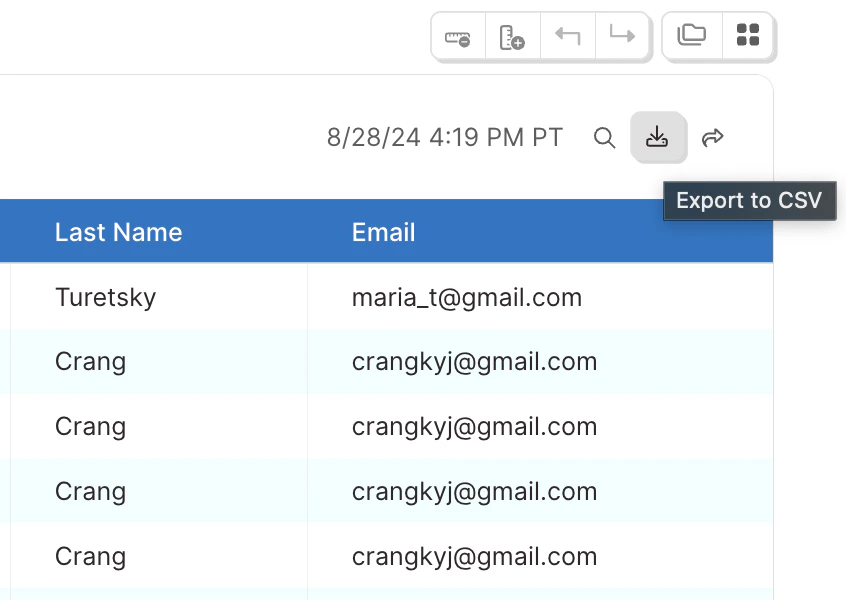
To export, click **Export to CSV** at the top right of any table or chart.
## Creating and managing views
Views are individual visualizations inside a Visualize step. Show them as tables, featured metrics, or charts.
Arrange views as **tabs** or **tiles**:
* **Tabs** look like spreadsheet tabs along the top of the page. Drag to rearrange.
* **Tiles** show every view at once. Resize with the handles, drag to rearrange.
A few things to know:
* Views refresh when the flow runs, when the base data changes, or when you change view settings.
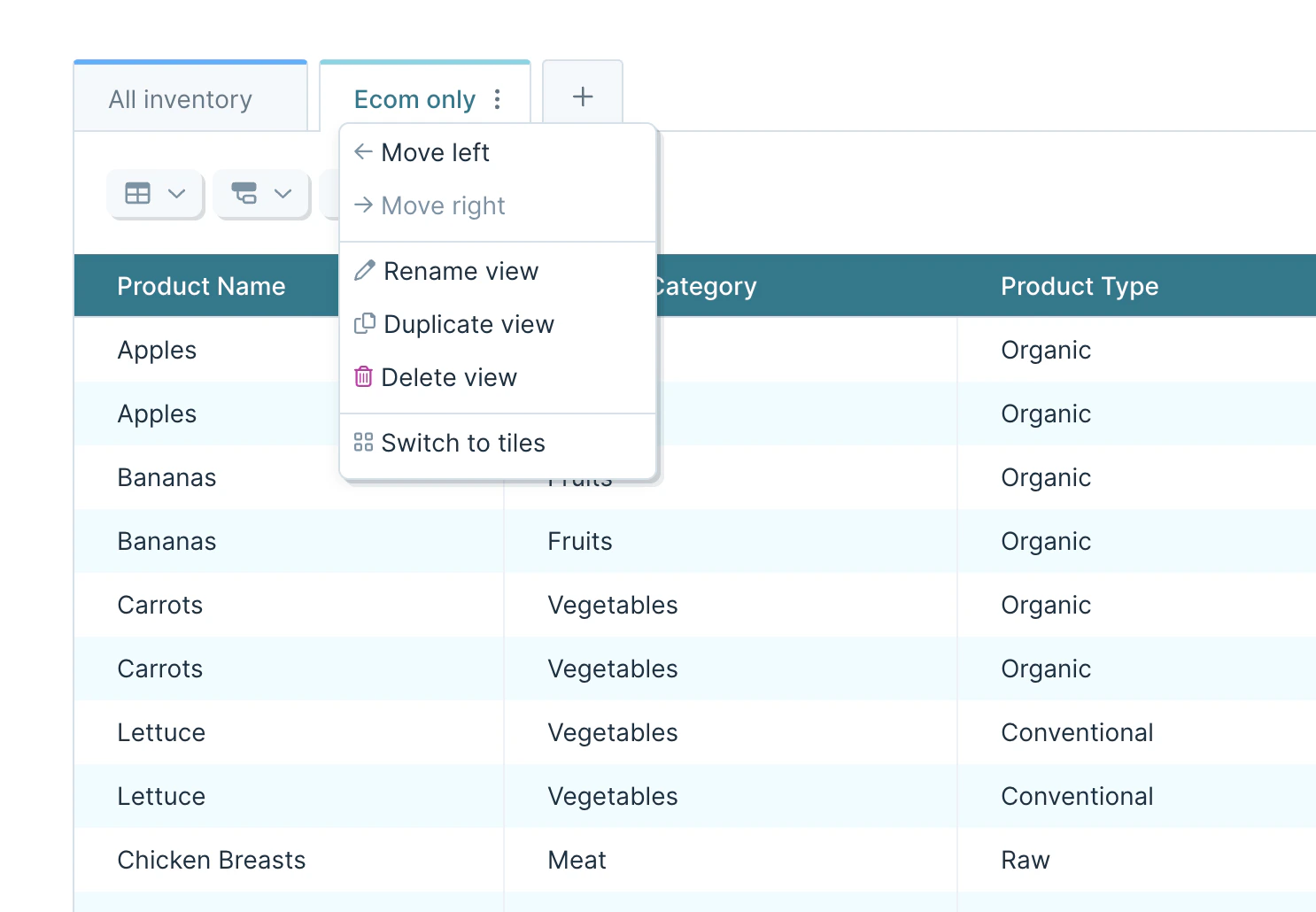
* The overflow menu next to a view name lets you move, rename, duplicate, or delete it. The same menu switches the page layout between tabs and tiles.
* Add new views with the plus icon next to the last tab, or the **Add view** button below the last tile. With a lot of tabs, use the tab list menu on the right side.
* Duplicated and new tab views land in the **private views** section — scroll down to find them.
## View types
Pick a view type from the **Table/chart options** menu.
### Tables
Tables are the default. They work for any rows of data, styled, calculated, grouped, sorted, or filtered. The table options menu (top left, below the tab title) holds column formatting and aggregation calculations.
### Featured metrics
Featured metrics show a single column calculation prominently — a total, an average, a count. Each metric can be renamed, given a color, and formatted (date, number, percent, currency, accounting). The metrics options menu sits in the same spot as table options, marked with a `#`.
### Charts and graphs
Supported chart types: column, line, area, scatter, and mixed (multiple types combined). The chart options menu (mini bar graph icon) controls labels, colors, gridlines, and legend placement.
**X axis.** Charts plot one value on the horizontal X axis, typically dates or categories. Use the grouping option to aggregate values — for example, set the X axis to day-of-week and group to see total transactions per day. Without grouping, values plot exactly as they appear. The X axis options dropdown handles finer formatting.
**Y axis.** Charts can have up to two Y axes (left, right, or both). Each axis can hold any number of **series** — multiple series produce multiple bars, lines, or dots, depending on chart type. A second Y axis adds a second scale on the right, useful for comparing two metrics on different orders of magnitude (revenue vs. conversion rate, for example). Each series aggregates independently — sum, mean, median, etc.
**Categories and stacking.** Depending on axis choices and chart type, you'll see different category and stacking options:
* **Categorize by …** — split a Y axis value by a subcategory. Example: split total revenue by store location to get one bar per store.
* **Categorize and stack by …** — same split, stacked into one bar per X-axis value with colored segments per subcategory.
* **Stack series** — stack multiple series on a single X-axis value into one bar.
**Tips:**
* Add a chart title from the **Table/chart options** menu.
* Click an item in the legend to temporarily hide that series; click again to show it.
* Charts and graphs export as CSVs that mirror the underlying table.
## Calculations, grouping, sorting, filtering
**Column calculations.** One calculation per column:
* **Count all** — rows in the entire table and within each group
* **Count unique** — unique values in the column (case- and space-sensitive)
* **Count empty** / **Count not empty** — blank vs. populated cells
* **Sum** — total of numeric values; non-numeric and blank cells skipped
* **Average** — sum / count of values used; non-numeric and blank skipped
* **Median** — middle value where half are higher and half are lower
* **Min** / **Max** — smallest / largest numeric value
If a calculation can't be produced, the cell shows `--`.
**Grouping.** Tables can be grouped up to six times. Groups apply in nested order — the first rule creates top-level groups, each subsequent rule creates subgroups. After six groups, **+ Add grouping** is disabled. Sort options inside the group rules control the order groups display; normal sort rules order rows within each group.
**Sorts.** Click **Sort** (or use the view options menu) to add a sort rule.
**Filters.** Click **Filter** (or use the view options menu) to add a filter rule. Date filters support both relative ranges ("Last 7 days") and exact ranges via **Filter dates to…**.
## Quick filters
Click **Quick Filter** at the top right of the dashboard to toggle the filter bar. Use **Add quick filter** or **Add date filter** to filter specific columns across every view on the page.
* Quick filters are personal — they don't affect other users — and refresh resets them.
* After eight seconds, the current combination is saved in the **Recents** drawer on the right side of the filter bar. Saved sets reapply with one click and stay private to you.
* Quick filters require at least one table on the flow. Click above the first table on the published flow page to add one. The filter bar follows you as you scroll.
* Multiple quick filters combine with AND logic and apply on top of any filters set on individual views. Use the clear icon to remove all filters at once.
## Data formatting
Format columns, metrics, and axes from the **Table/Chart Options** button (leftmost in the control row). Use auto-format or pick a category and format manually.
For charts, the X axis is auto-formatted by default. All series in each Y axis share a single format. Adjust axis formatting with the gear icon next to the axis name.
Formatting applies to columns, group aggregations, the grand total row, and featured metrics. Grouping uses the underlying unformatted value to decide which row goes into which group.
For dates, format is auto-detected. If your dates aren't recognized, click the three dots next to the output format field and enter a custom starting format.
Valid format tokens:
If the output format uses a token not present in the input (for example, going from `MM-DD` to `MM-DD-YYYY`), the missing parts default to:
* Day → 1
* Month → January
* Year → 2000
Dates that don't match the starting format remain unformatted.
## Hiding and freezing
Use **Table/Chart Options** to hide columns from a view or freeze the first column or first row.
A few notes on hidden columns:
* They can still be used for sorting, grouping, and filtering — those rules apply before hiding.
* They don't appear in search results unless **Display all columns** is enabled.
* They can be filtered with quick filters.
* They are included in CSV exports.
Frozen columns and rows stay in place while the rest of the table scrolls.
## Conditional formatting
From the table options menu, click **Add color rule** to apply formatting to a column.
Three rule types:
* **Set color** — apply one color to every cell in the column.
* **Color rule** — color cells that match a condition.
* **Color scale** — apply a 2- or 3-color gradient across the column.
The same menu removes existing colors.
**Color rule** supports a range of conditional operators:
**Color scale.** With two colors, the first goes to the minimum value and the second to the maximum. With three colors, the middle color is centered between min and max by default. Cells with values between breakpoints get a blended color. If you set a custom max or min, any value above the max gets the max color and any value below the min gets the min color.
Click the ellipsis menu next to the format dropdown to switch each breakpoint between a number, a percent, or the default min/max value.
Scales work on dates, numbers, currency, and other numeric formats.
**Multiple rules** on the same column evaluate top-down. The first rule that matches a cell wins; cells already colored by an earlier rule are skipped on later rules. A **set color** or **color scale** rule colors every cell, so any rules below them won't have cells left to evaluate.
Existing [table views](https://parabola.io/blog/introducing-table-views-filter-sort-style-and-share-your-data) that used column emphasis migrate automatically to a set color rule.
## Related steps
* [Send to Parabola Table](/product/integration/table) — store historical data the Visualize step can pull from
* [Filter rows](/product/transform/filter-rows) — trim the dataset before visualizing
* [Format dates](/product/transform/format-dates) — for clean date axes
* [Format numbers](/product/transform/format-numbers) — for currency, percent, and other number formatting upstream of the chart
* [Send to Slack](/product/integration/slack) — push key metrics to a channel alongside the dashboard
 *All sections below related to visualizations that do show up in dashboards and can be saved.*
# Dashboard visualizations
## Add a Visualize step
When first added and connected to another step, Visualize expands and shows the incoming data as a table on the canvas. Click **Edit this View** to open the step and customize the visualization or add new views.
*All sections below related to visualizations that do show up in dashboards and can be saved.*
# Dashboard visualizations
## Add a Visualize step
When first added and connected to another step, Visualize expands and shows the incoming data as a table on the canvas. Click **Edit this View** to open the step and customize the visualization or add new views.
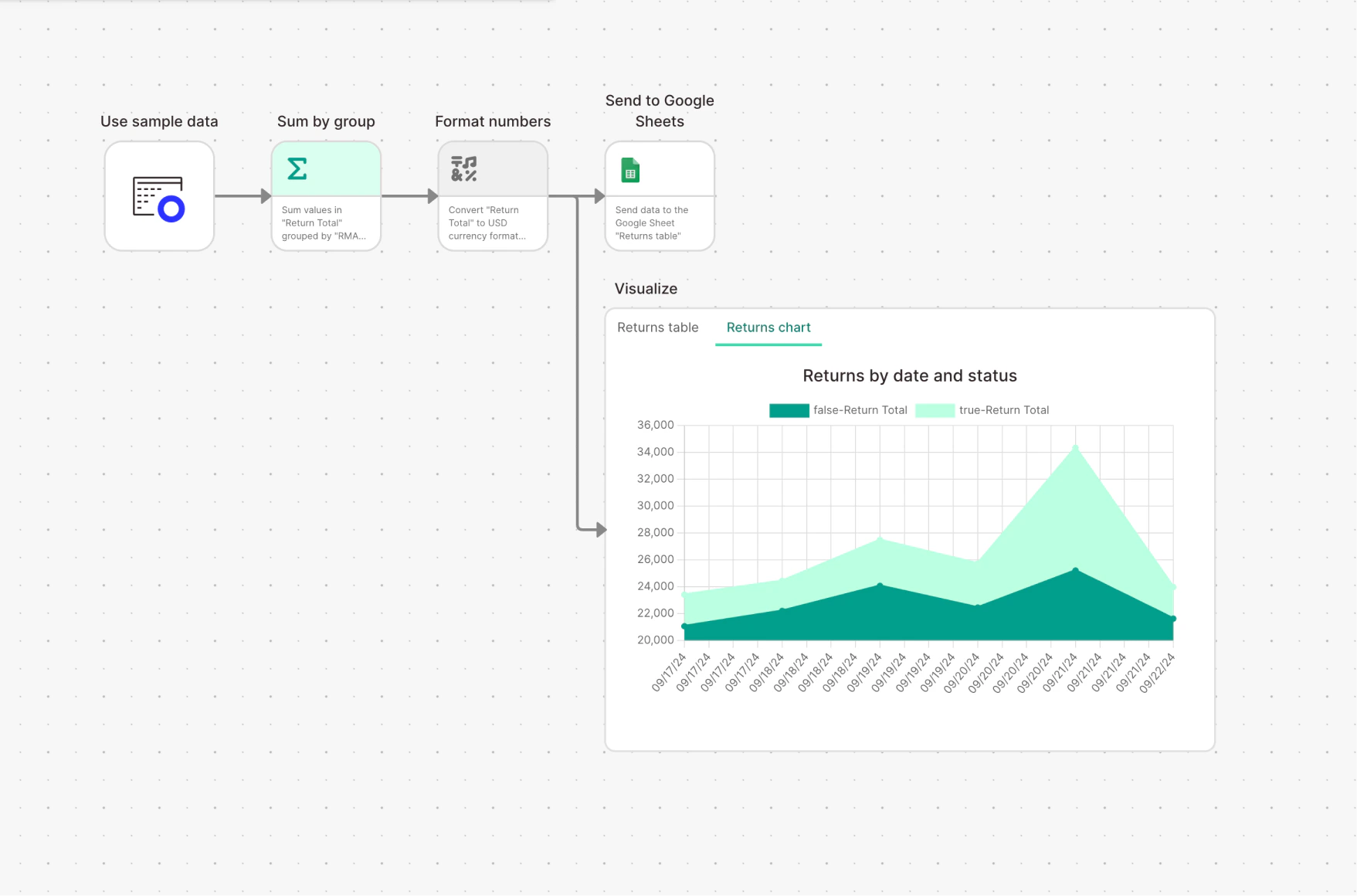 A single Visualize step can hold any number of views. Each view shares the same input data but can be configured differently — one as a table, another as a column chart, another as a featured metric.
**Show on dashboard** is on by default. Disable it on a view to keep that view on the canvas only.
**Resizing.** Click the collapse button in the top right of an expanded step to shrink it back to a normal size. Use the expand button to open it again. Expanded views can be resized using the handle in the bottom-right corner.
## Sharing
Anyone with access to the flow can see the dashboard:
* **Can edit** — edit and create views. Changes are immediately visible to everyone with access.
* **Can view** — see all views, can't make changes.
To share a single view, share the entire flow ([instructions](/product/canvas/sharing-a-flow)) or click **Share** from inside the view. Sharing a view grants flow access and links the recipient straight to that view.
A single Visualize step can hold any number of views. Each view shares the same input data but can be configured differently — one as a table, another as a column chart, another as a featured metric.
**Show on dashboard** is on by default. Disable it on a view to keep that view on the canvas only.
**Resizing.** Click the collapse button in the top right of an expanded step to shrink it back to a normal size. Use the expand button to open it again. Expanded views can be resized using the handle in the bottom-right corner.
## Sharing
Anyone with access to the flow can see the dashboard:
* **Can edit** — edit and create views. Changes are immediately visible to everyone with access.
* **Can view** — see all views, can't make changes.
To share a single view, share the entire flow ([instructions](/product/canvas/sharing-a-flow)) or click **Share** from inside the view. Sharing a view grants flow access and links the recipient straight to that view.
 To export, click **Export to CSV** at the top right of any table or chart.
 ## Creating and managing views
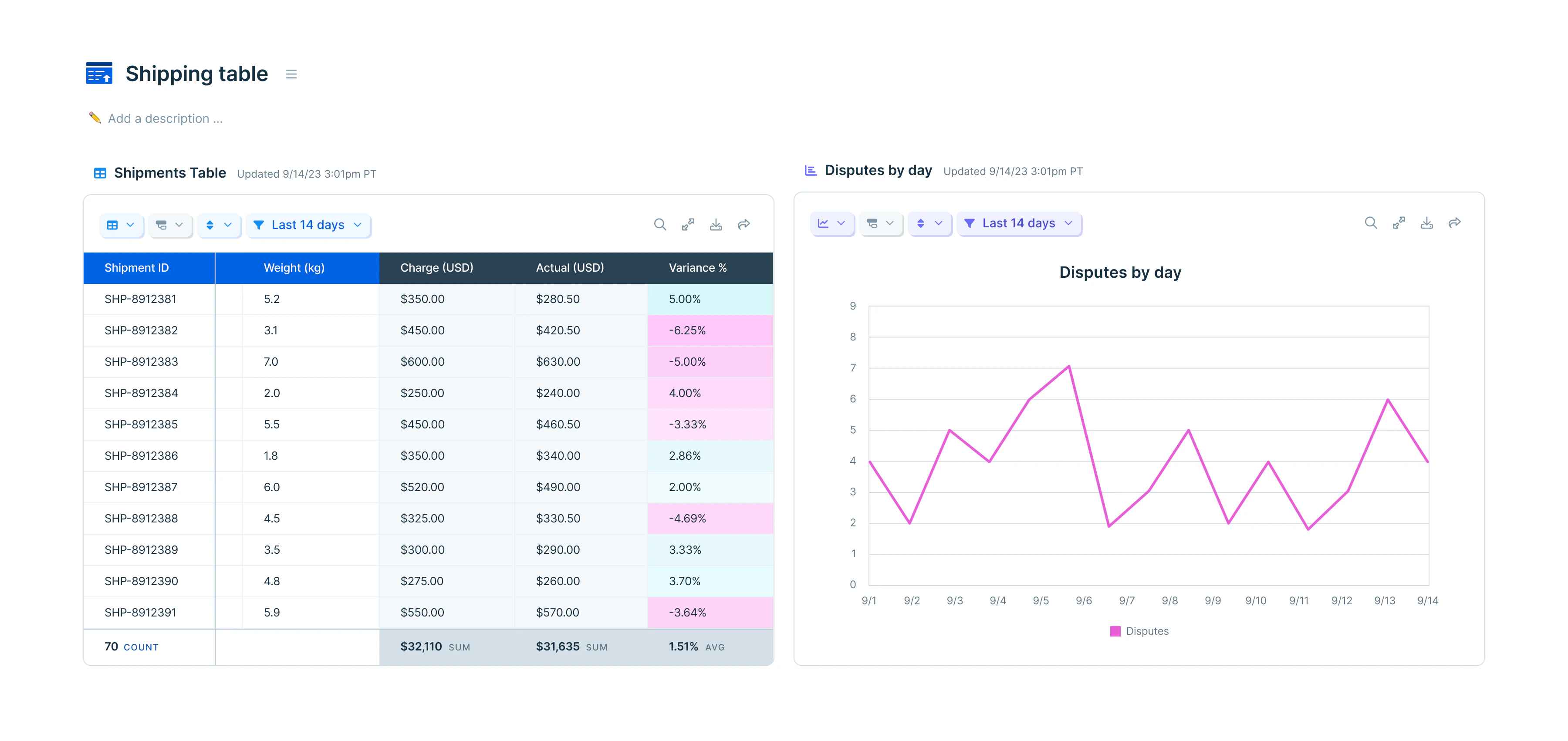
Views are individual visualizations inside a Visualize step. Show them as tables, featured metrics, or charts.
Arrange views as **tabs** or **tiles**:
* **Tabs** look like spreadsheet tabs along the top of the page. Drag to rearrange.
* **Tiles** show every view at once. Resize with the handles, drag to rearrange.
## Creating and managing views
Views are individual visualizations inside a Visualize step. Show them as tables, featured metrics, or charts.
Arrange views as **tabs** or **tiles**:
* **Tabs** look like spreadsheet tabs along the top of the page. Drag to rearrange.
* **Tiles** show every view at once. Resize with the handles, drag to rearrange.
 A few things to know:
* Views refresh when the flow runs, when the base data changes, or when you change view settings.
* The overflow menu next to a view name lets you move, rename, duplicate, or delete it. The same menu switches the page layout between tabs and tiles.
* Add new views with the plus icon next to the last tab, or the **Add view** button below the last tile. With a lot of tabs, use the tab list menu on the right side.
* Duplicated and new tab views land in the **private views** section — scroll down to find them.
## View types
Pick a view type from the **Table/chart options** menu.
### Tables
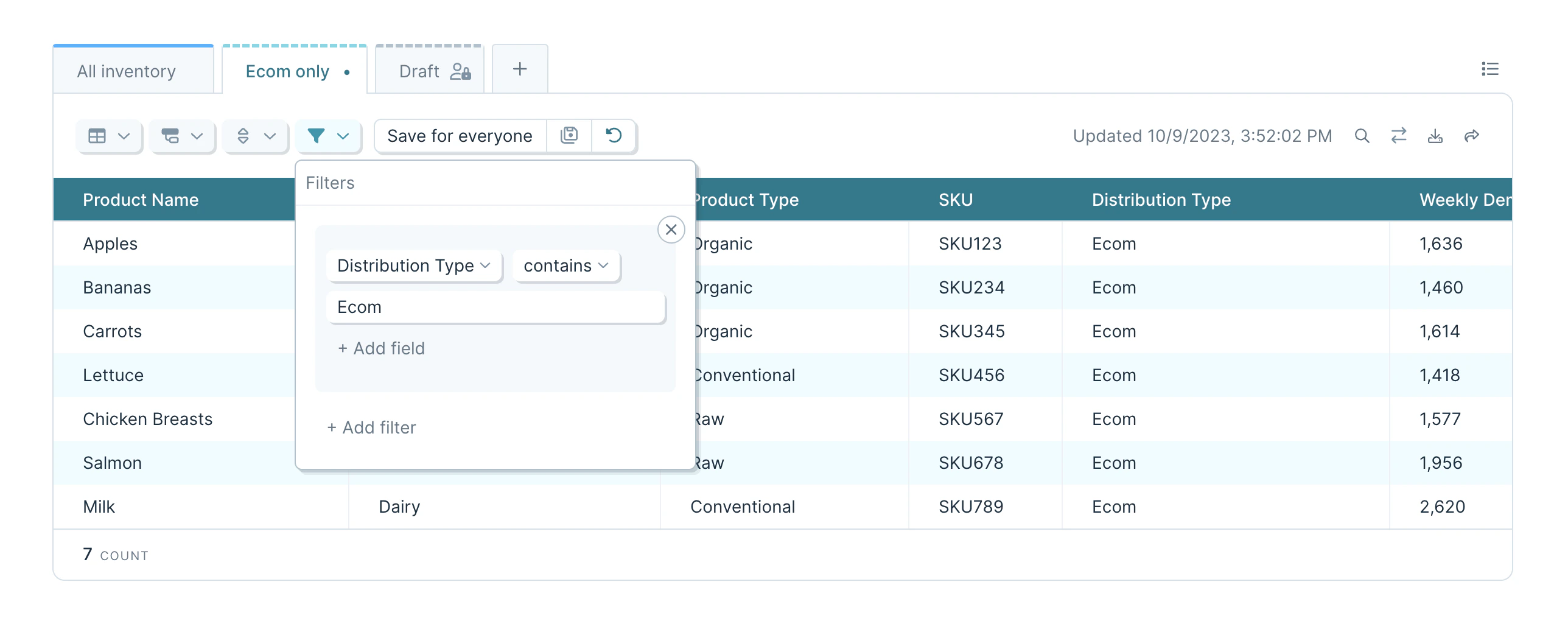
Tables are the default. They work for any rows of data, styled, calculated, grouped, sorted, or filtered. The table options menu (top left, below the tab title) holds column formatting and aggregation calculations.
A few things to know:
* Views refresh when the flow runs, when the base data changes, or when you change view settings.
* The overflow menu next to a view name lets you move, rename, duplicate, or delete it. The same menu switches the page layout between tabs and tiles.
* Add new views with the plus icon next to the last tab, or the **Add view** button below the last tile. With a lot of tabs, use the tab list menu on the right side.
* Duplicated and new tab views land in the **private views** section — scroll down to find them.
## View types
Pick a view type from the **Table/chart options** menu.
### Tables
Tables are the default. They work for any rows of data, styled, calculated, grouped, sorted, or filtered. The table options menu (top left, below the tab title) holds column formatting and aggregation calculations.
 ### Featured metrics
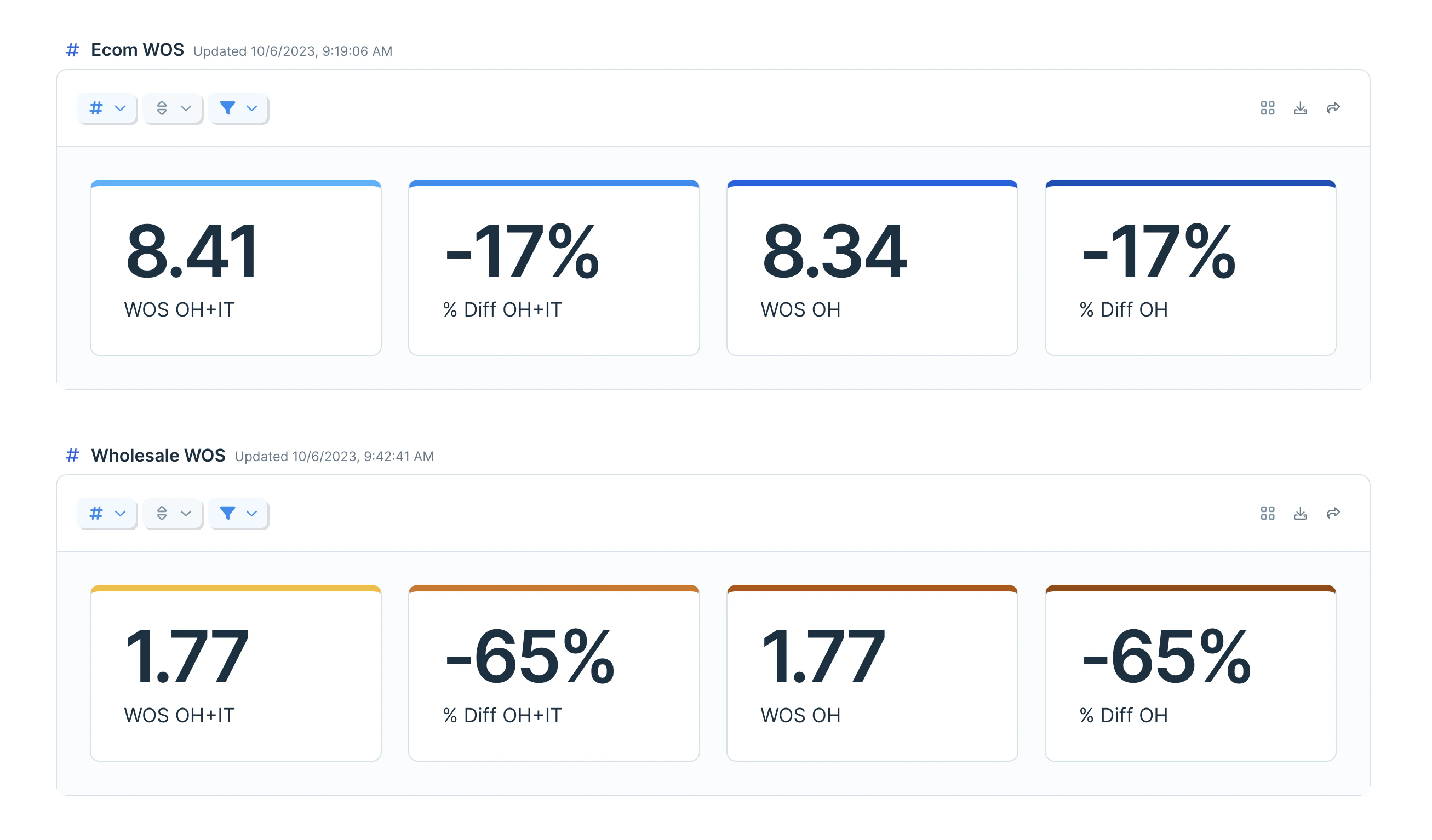
Featured metrics show a single column calculation prominently — a total, an average, a count. Each metric can be renamed, given a color, and formatted (date, number, percent, currency, accounting). The metrics options menu sits in the same spot as table options, marked with a `#`.
### Featured metrics
Featured metrics show a single column calculation prominently — a total, an average, a count. Each metric can be renamed, given a color, and formatted (date, number, percent, currency, accounting). The metrics options menu sits in the same spot as table options, marked with a `#`.
 ### Charts and graphs
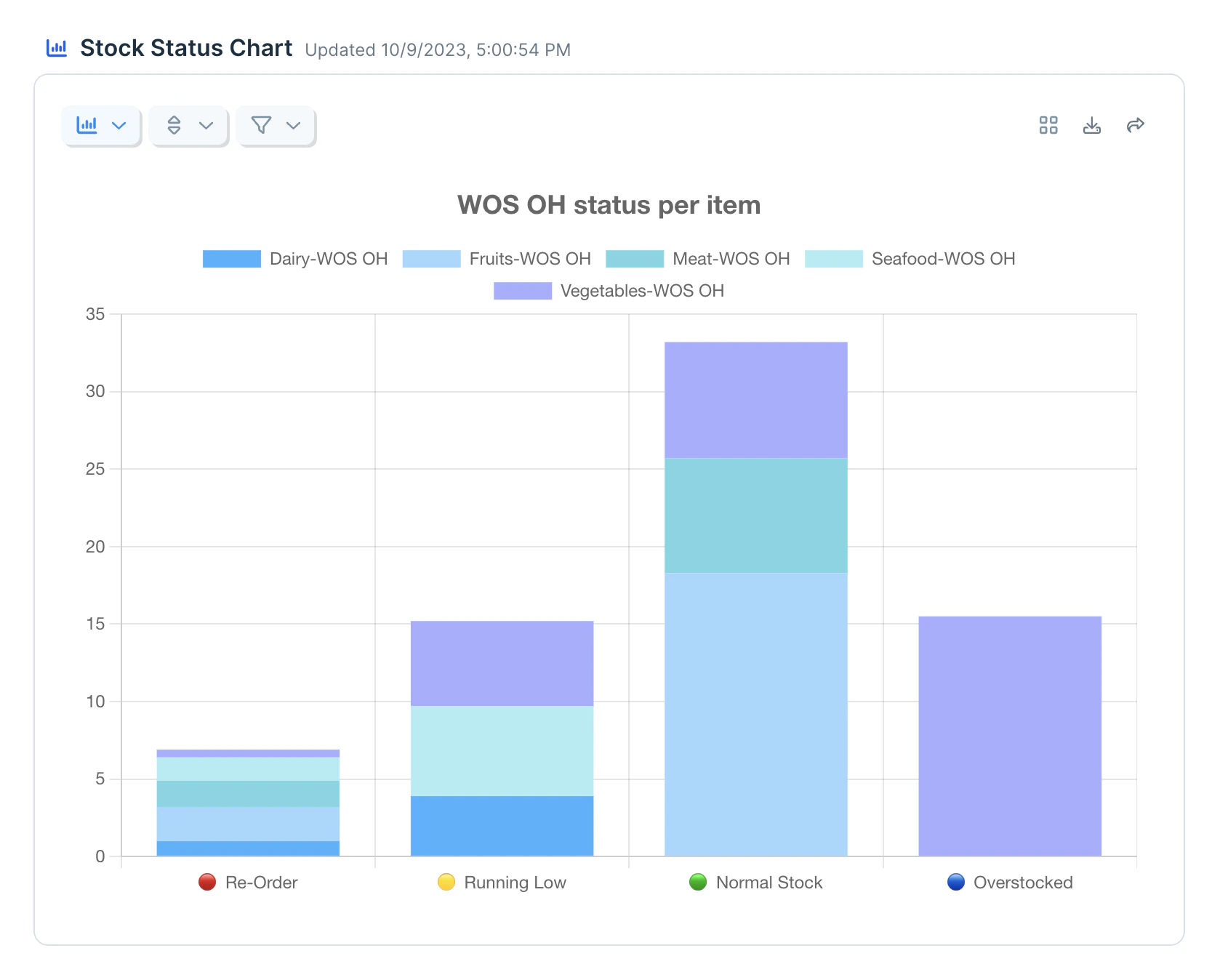
Supported chart types: column, line, area, scatter, and mixed (multiple types combined). The chart options menu (mini bar graph icon) controls labels, colors, gridlines, and legend placement.
### Charts and graphs
Supported chart types: column, line, area, scatter, and mixed (multiple types combined). The chart options menu (mini bar graph icon) controls labels, colors, gridlines, and legend placement.
 **X axis.** Charts plot one value on the horizontal X axis, typically dates or categories. Use the grouping option to aggregate values — for example, set the X axis to day-of-week and group to see total transactions per day. Without grouping, values plot exactly as they appear. The X axis options dropdown handles finer formatting.
**Y axis.** Charts can have up to two Y axes (left, right, or both). Each axis can hold any number of **series** — multiple series produce multiple bars, lines, or dots, depending on chart type. A second Y axis adds a second scale on the right, useful for comparing two metrics on different orders of magnitude (revenue vs. conversion rate, for example). Each series aggregates independently — sum, mean, median, etc.
**Categories and stacking.** Depending on axis choices and chart type, you'll see different category and stacking options:
* **Categorize by …** — split a Y axis value by a subcategory. Example: split total revenue by store location to get one bar per store.
* **Categorize and stack by …** — same split, stacked into one bar per X-axis value with colored segments per subcategory.
* **Stack series** — stack multiple series on a single X-axis value into one bar.
**Tips:**
* Add a chart title from the **Table/chart options** menu.
* Click an item in the legend to temporarily hide that series; click again to show it.
* Charts and graphs export as CSVs that mirror the underlying table.
## Calculations, grouping, sorting, filtering
**Column calculations.** One calculation per column:
* **Count all** — rows in the entire table and within each group
* **Count unique** — unique values in the column (case- and space-sensitive)
* **Count empty** / **Count not empty** — blank vs. populated cells
* **Sum** — total of numeric values; non-numeric and blank cells skipped
* **Average** — sum / count of values used; non-numeric and blank skipped
* **Median** — middle value where half are higher and half are lower
* **Min** / **Max** — smallest / largest numeric value
If a calculation can't be produced, the cell shows `--`.
**Grouping.** Tables can be grouped up to six times. Groups apply in nested order — the first rule creates top-level groups, each subsequent rule creates subgroups. After six groups, **+ Add grouping** is disabled. Sort options inside the group rules control the order groups display; normal sort rules order rows within each group.
**Sorts.** Click **Sort** (or use the view options menu) to add a sort rule.
**Filters.** Click **Filter** (or use the view options menu) to add a filter rule. Date filters support both relative ranges ("Last 7 days") and exact ranges via **Filter dates to…**.
## Quick filters
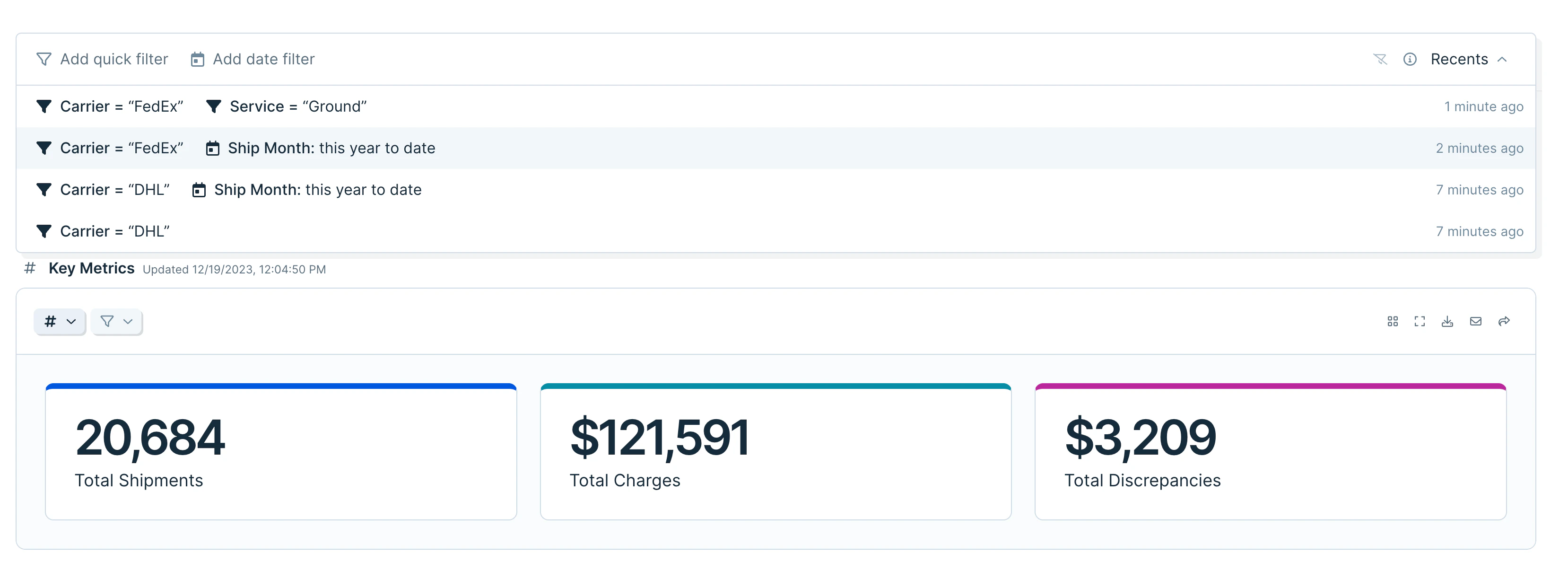
Click **Quick Filter** at the top right of the dashboard to toggle the filter bar. Use **Add quick filter** or **Add date filter** to filter specific columns across every view on the page.
* Quick filters are personal — they don't affect other users — and refresh resets them.
* After eight seconds, the current combination is saved in the **Recents** drawer on the right side of the filter bar. Saved sets reapply with one click and stay private to you.
* Quick filters require at least one table on the flow. Click above the first table on the published flow page to add one. The filter bar follows you as you scroll.
* Multiple quick filters combine with AND logic and apply on top of any filters set on individual views. Use the clear icon to remove all filters at once.
**X axis.** Charts plot one value on the horizontal X axis, typically dates or categories. Use the grouping option to aggregate values — for example, set the X axis to day-of-week and group to see total transactions per day. Without grouping, values plot exactly as they appear. The X axis options dropdown handles finer formatting.
**Y axis.** Charts can have up to two Y axes (left, right, or both). Each axis can hold any number of **series** — multiple series produce multiple bars, lines, or dots, depending on chart type. A second Y axis adds a second scale on the right, useful for comparing two metrics on different orders of magnitude (revenue vs. conversion rate, for example). Each series aggregates independently — sum, mean, median, etc.
**Categories and stacking.** Depending on axis choices and chart type, you'll see different category and stacking options:
* **Categorize by …** — split a Y axis value by a subcategory. Example: split total revenue by store location to get one bar per store.
* **Categorize and stack by …** — same split, stacked into one bar per X-axis value with colored segments per subcategory.
* **Stack series** — stack multiple series on a single X-axis value into one bar.
**Tips:**
* Add a chart title from the **Table/chart options** menu.
* Click an item in the legend to temporarily hide that series; click again to show it.
* Charts and graphs export as CSVs that mirror the underlying table.
## Calculations, grouping, sorting, filtering
**Column calculations.** One calculation per column:
* **Count all** — rows in the entire table and within each group
* **Count unique** — unique values in the column (case- and space-sensitive)
* **Count empty** / **Count not empty** — blank vs. populated cells
* **Sum** — total of numeric values; non-numeric and blank cells skipped
* **Average** — sum / count of values used; non-numeric and blank skipped
* **Median** — middle value where half are higher and half are lower
* **Min** / **Max** — smallest / largest numeric value
If a calculation can't be produced, the cell shows `--`.
**Grouping.** Tables can be grouped up to six times. Groups apply in nested order — the first rule creates top-level groups, each subsequent rule creates subgroups. After six groups, **+ Add grouping** is disabled. Sort options inside the group rules control the order groups display; normal sort rules order rows within each group.
**Sorts.** Click **Sort** (or use the view options menu) to add a sort rule.
**Filters.** Click **Filter** (or use the view options menu) to add a filter rule. Date filters support both relative ranges ("Last 7 days") and exact ranges via **Filter dates to…**.
## Quick filters
Click **Quick Filter** at the top right of the dashboard to toggle the filter bar. Use **Add quick filter** or **Add date filter** to filter specific columns across every view on the page.
* Quick filters are personal — they don't affect other users — and refresh resets them.
* After eight seconds, the current combination is saved in the **Recents** drawer on the right side of the filter bar. Saved sets reapply with one click and stay private to you.
* Quick filters require at least one table on the flow. Click above the first table on the published flow page to add one. The filter bar follows you as you scroll.
* Multiple quick filters combine with AND logic and apply on top of any filters set on individual views. Use the clear icon to remove all filters at once.
 ## Data formatting
Format columns, metrics, and axes from the **Table/Chart Options** button (leftmost in the control row). Use auto-format or pick a category and format manually.
For charts, the X axis is auto-formatted by default. All series in each Y axis share a single format. Adjust axis formatting with the gear icon next to the axis name.
Formatting applies to columns, group aggregations, the grand total row, and featured metrics. Grouping uses the underlying unformatted value to decide which row goes into which group.
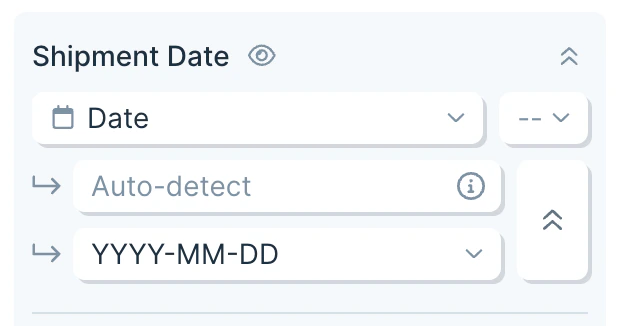
For dates, format is auto-detected. If your dates aren't recognized, click the three dots next to the output format field and enter a custom starting format.
## Data formatting
Format columns, metrics, and axes from the **Table/Chart Options** button (leftmost in the control row). Use auto-format or pick a category and format manually.
For charts, the X axis is auto-formatted by default. All series in each Y axis share a single format. Adjust axis formatting with the gear icon next to the axis name.
Formatting applies to columns, group aggregations, the grand total row, and featured metrics. Grouping uses the underlying unformatted value to decide which row goes into which group.
For dates, format is auto-detected. If your dates aren't recognized, click the three dots next to the output format field and enter a custom starting format.
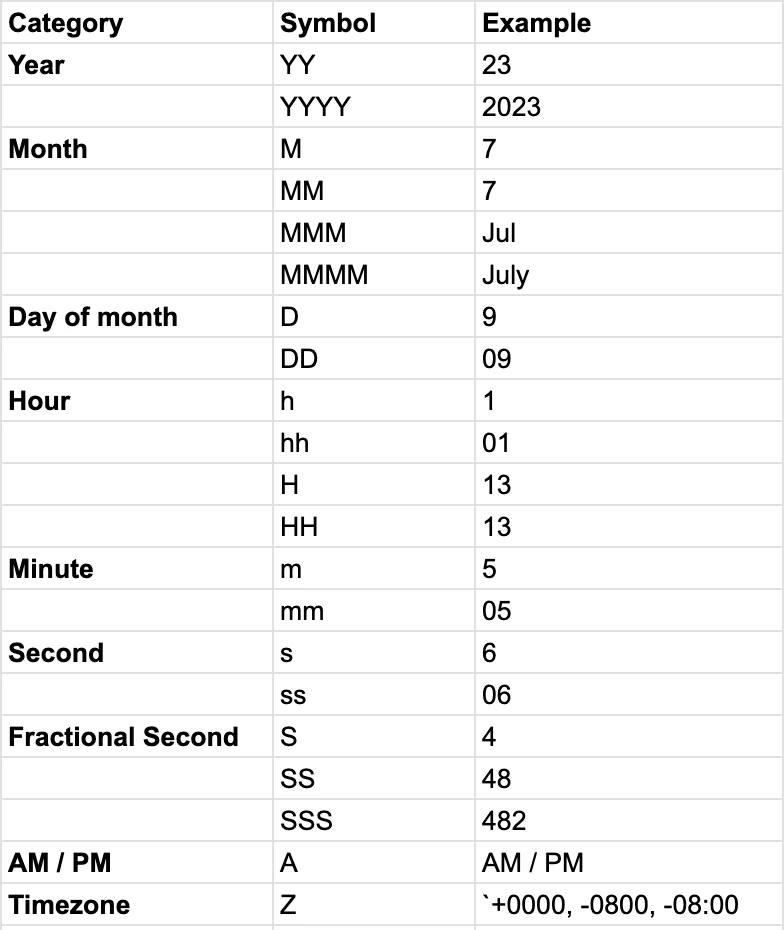
 Valid format tokens:
 If the output format uses a token not present in the input (for example, going from `MM-DD` to `MM-DD-YYYY`), the missing parts default to:
* Day → 1
* Month → January
* Year → 2000
Dates that don't match the starting format remain unformatted.
## Hiding and freezing
Use **Table/Chart Options** to hide columns from a view or freeze the first column or first row.
A few notes on hidden columns:
* They can still be used for sorting, grouping, and filtering — those rules apply before hiding.
* They don't appear in search results unless **Display all columns** is enabled.
* They can be filtered with quick filters.
* They are included in CSV exports.
Frozen columns and rows stay in place while the rest of the table scrolls.
## Conditional formatting
From the table options menu, click **Add color rule** to apply formatting to a column.
If the output format uses a token not present in the input (for example, going from `MM-DD` to `MM-DD-YYYY`), the missing parts default to:
* Day → 1
* Month → January
* Year → 2000
Dates that don't match the starting format remain unformatted.
## Hiding and freezing
Use **Table/Chart Options** to hide columns from a view or freeze the first column or first row.
A few notes on hidden columns:
* They can still be used for sorting, grouping, and filtering — those rules apply before hiding.
* They don't appear in search results unless **Display all columns** is enabled.
* They can be filtered with quick filters.
* They are included in CSV exports.
Frozen columns and rows stay in place while the rest of the table scrolls.
## Conditional formatting
From the table options menu, click **Add color rule** to apply formatting to a column.
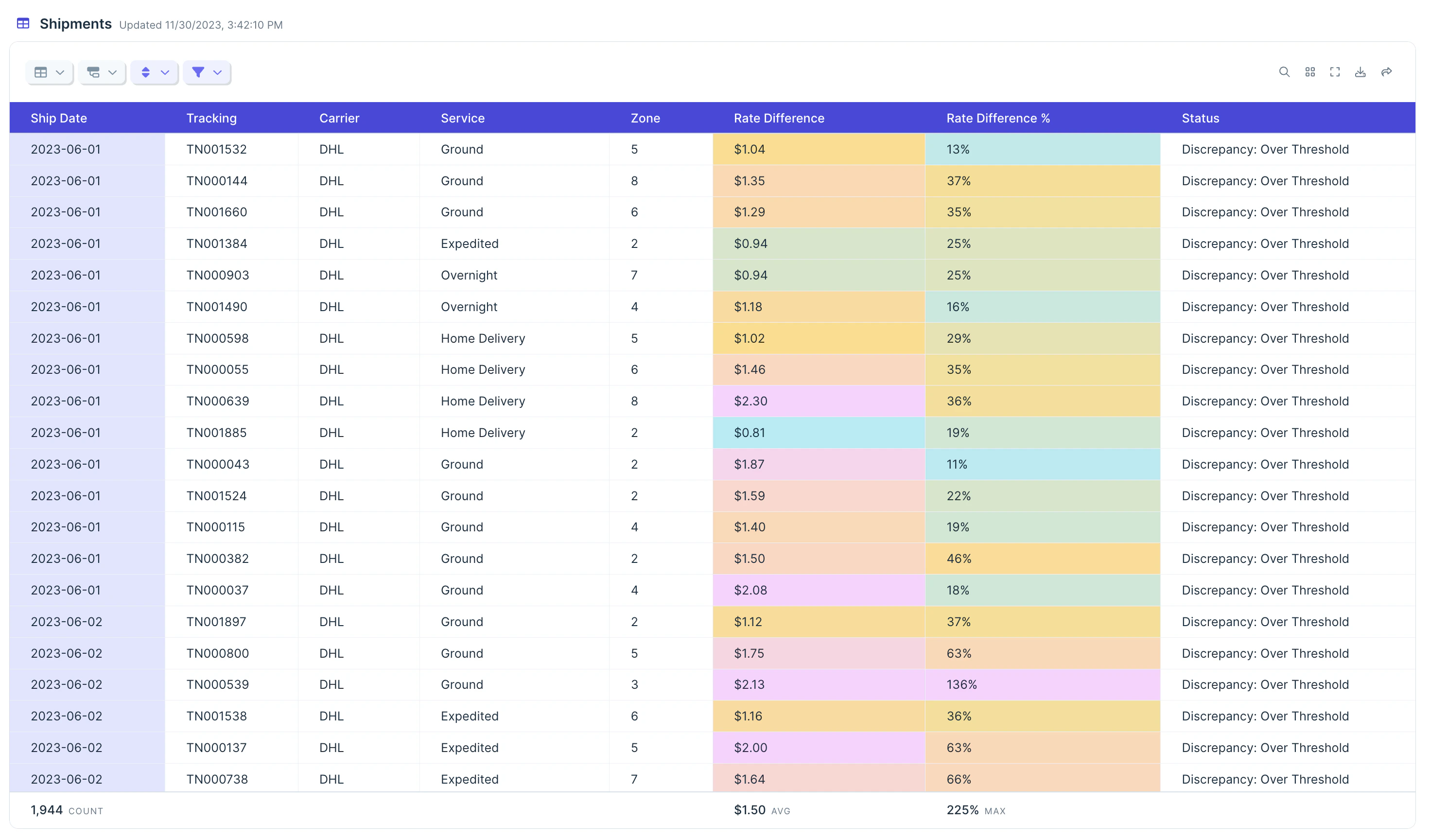 Three rule types:
* **Set color** — apply one color to every cell in the column.
* **Color rule** — color cells that match a condition.
* **Color scale** — apply a 2- or 3-color gradient across the column.
The same menu removes existing colors.
Three rule types:
* **Set color** — apply one color to every cell in the column.
* **Color rule** — color cells that match a condition.
* **Color scale** — apply a 2- or 3-color gradient across the column.
The same menu removes existing colors.
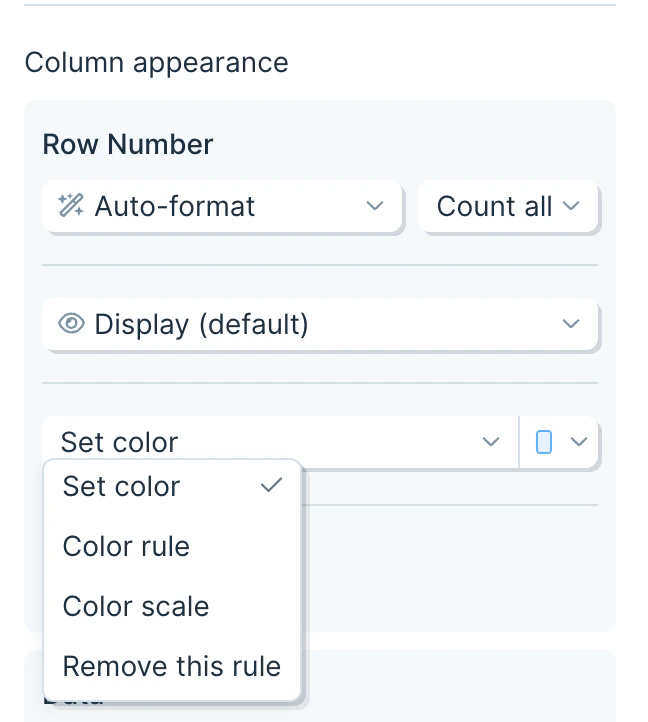 **Color rule** supports a range of conditional operators:
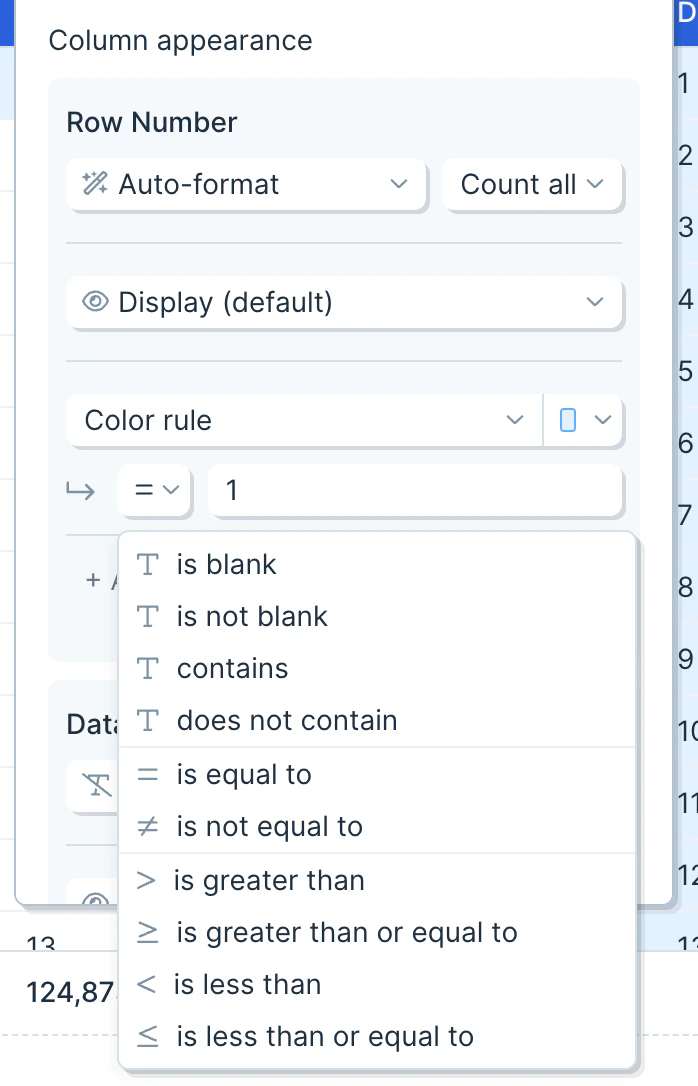 **Color scale.** With two colors, the first goes to the minimum value and the second to the maximum. With three colors, the middle color is centered between min and max by default. Cells with values between breakpoints get a blended color. If you set a custom max or min, any value above the max gets the max color and any value below the min gets the min color.
Click the ellipsis menu next to the format dropdown to switch each breakpoint between a number, a percent, or the default min/max value.
**Color scale.** With two colors, the first goes to the minimum value and the second to the maximum. With three colors, the middle color is centered between min and max by default. Cells with values between breakpoints get a blended color. If you set a custom max or min, any value above the max gets the max color and any value below the min gets the min color.
Click the ellipsis menu next to the format dropdown to switch each breakpoint between a number, a percent, or the default min/max value.
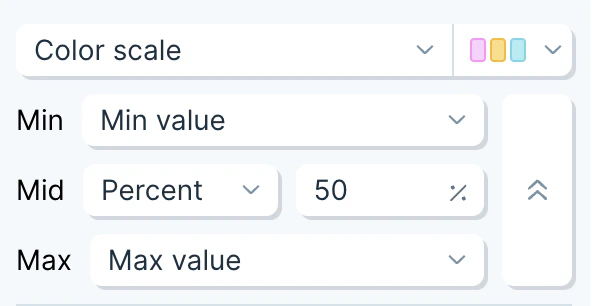 Scales work on dates, numbers, currency, and other numeric formats.
**Multiple rules** on the same column evaluate top-down. The first rule that matches a cell wins; cells already colored by an earlier rule are skipped on later rules. A **set color** or **color scale** rule colors every cell, so any rules below them won't have cells left to evaluate.
Existing [table views](https://parabola.io/blog/introducing-table-views-filter-sort-style-and-share-your-data) that used column emphasis migrate automatically to a set color rule.
## Related steps
* [Send to Parabola Table](/product/integration/table) — store historical data the Visualize step can pull from
* [Filter rows](/product/transform/filter-rows) — trim the dataset before visualizing
* [Format dates](/product/transform/format-dates) — for clean date axes
* [Format numbers](/product/transform/format-numbers) — for currency, percent, and other number formatting upstream of the chart
* [Send to Slack](/product/integration/slack) — push key metrics to a channel alongside the dashboard
Scales work on dates, numbers, currency, and other numeric formats.
**Multiple rules** on the same column evaluate top-down. The first rule that matches a cell wins; cells already colored by an earlier rule are skipped on later rules. A **set color** or **color scale** rule colors every cell, so any rules below them won't have cells left to evaluate.
Existing [table views](https://parabola.io/blog/introducing-table-views-filter-sort-style-and-share-your-data) that used column emphasis migrate automatically to a set color rule.
## Related steps
* [Send to Parabola Table](/product/integration/table) — store historical data the Visualize step can pull from
* [Filter rows](/product/transform/filter-rows) — trim the dataset before visualizing
* [Format dates](/product/transform/format-dates) — for clean date axes
* [Format numbers](/product/transform/format-numbers) — for currency, percent, and other number formatting upstream of the chart
* [Send to Slack](/product/integration/slack) — push key metrics to a channel alongside the dashboard