Inventory reconciliation

Reconcile inventory across your ERP, WMS, and storefront. Flag every SKU that's out of sync between systems and surface what's missing where.

The prompt

I want to reconcile my inventory across Cin7, Shopify, and ShipHero by SKU. Build me a flow that compares on-hand quantities across all three, flags anything that's out of sync, and labels each SKU as in sync, out of sync, or missing in a system. Show me both the full table and a filtered view of just the discrepant ones.

Just copy and paste the prompt into a new Parabola flow to get started.
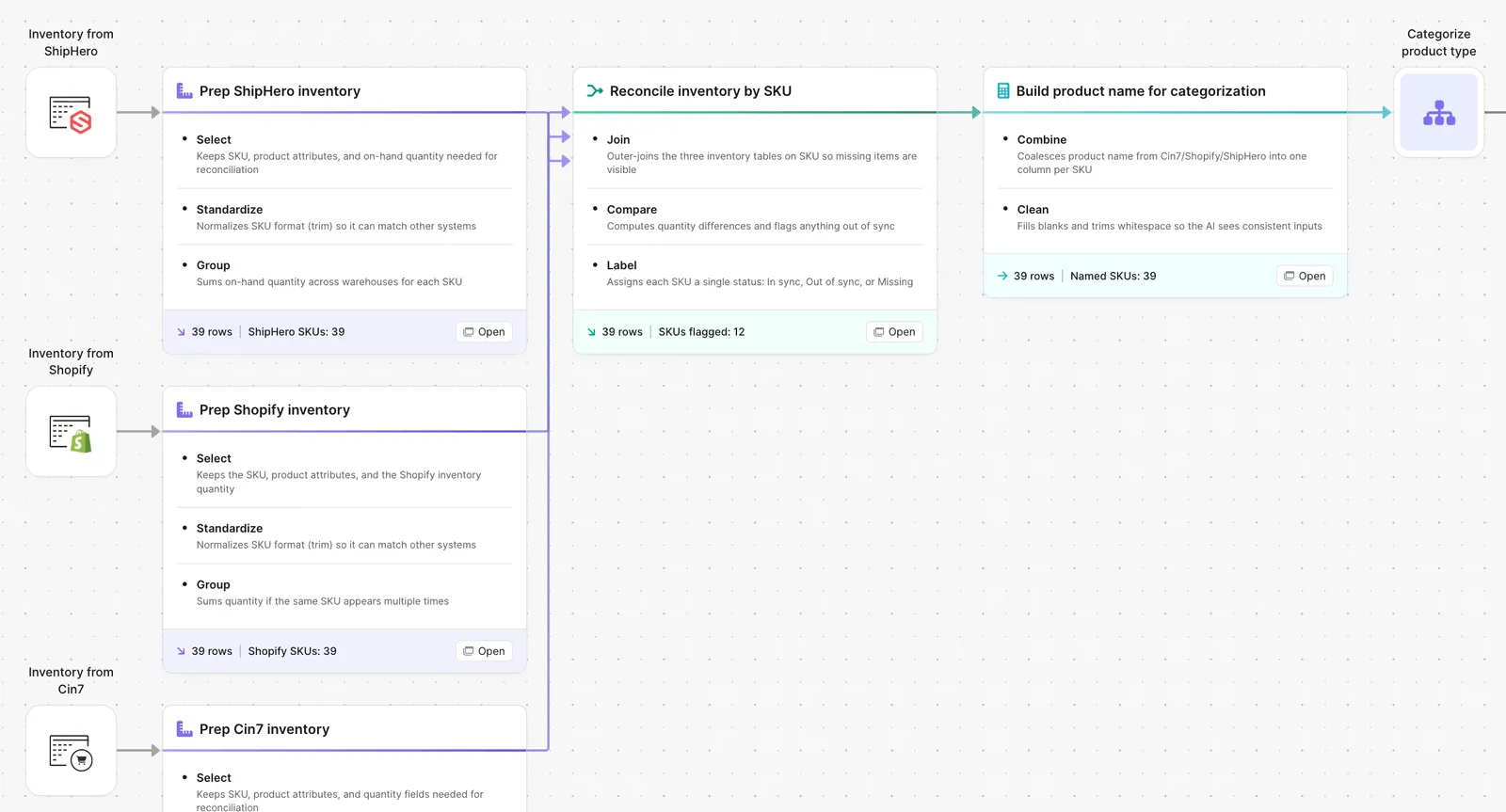
Parabola flow reconciling inventory across ShipHero, Shopify, and Cin7

What Parabola builds

A workflow with seven steps you can edit:

1. Pull on-hand from each source. Cin7, Shopify, ShipHero, NetSuite, your 3PL portal. Whatever the systems are, the flow connects to each one.

2. Standardize the SKU. Trim spaces, normalize casing, strip the retailer prefix. Same SKU across systems means same row across systems.

3. Outer join the systems. One row per SKU with one column per source.

4. Calculate the deltas. Difference between each pair of systems, in units and percent.

5. Label every SKU. In sync, out of sync, missing in system A, missing in system B. The label is the column the ops team reads first.

6. Filter retired SKUs. The recon shouldn't flag a SKU you stopped selling six months ago. Optional rule to ignore anything tagged retired.

7. Output the report. Full reconciliation table for the record, plus a filtered view of just the discrepancies sorted with the worst first.

Why teams stop doing this manually

Inventory lives in five places and never agrees with itself. The ERP says 1,200 units. The WMS says 1,180. Shopify shows 1,194 available. The 3PL portal shows 1,160. Someone has to figure out which one is right before the team commits an order against any of them.

The manual version is a spreadsheet that pulls each source, lines them up by SKU, and runs the deltas by hand. It works fine for a quarterly check. It breaks the day someone needs it weekly. It breaks again the day a SKU code changes format in one system but not the others. By that point the reconciliation is the analyst's whole Monday.

The cost of getting this wrong is operational. Orders ship from a warehouse that doesn't have the units. Pre-orders release against availability that doesn't exist. The website shows in-stock for a SKU that's been sold out for a week. Customers feel each one of these.

How it works

Step 1. Paste the prompt.

Open Parabola, paste the prompt in section 2, and let it ask follow-up questions about which systems and how your SKU formatting differs across them.

Step 2. Connect your data.

API connections to your ERP, WMS, storefront, and 3PL. The flow refreshes against live data, not last week's export.

Step 3. Run it every cycle.

Daily, weekly, or on-demand. The flow runs against the latest data each time. New 3PL? Add a new source. New SKU format? Update the standardization rule.

FAQ

Does this work if my systems use different SKU formats?

Yes. The standardization step at the top of the flow handles trim, uppercase, prefix removal, and code mapping. Once SKUs are normalized, the comparison works across every system.

How do I handle retired or discontinued SKUs?

Add a filter rule that ignores SKUs tagged retired in your ERP, or upload a list of SKU codes to exclude. The flow re-applies that filter every run.

Can the flow handle more than three systems?

Yes. Add a new source pipeline for each system, run it through the same standardization, and join it into the comparison. Five or six systems is common.

What about variance tolerance? Sometimes a 1-unit gap is fine.?

The tolerance is a configurable threshold. Set it in units or percent. Anything inside tolerance is labeled in sync. Anything outside gets flagged.

How is this different from doing the recon in Excel?

Excel works fine for a quarterly check. It breaks when you need this weekly across five systems with SKU codes that change format. Parabola handles the messy inputs, runs on a schedule, and shows every decision so finance and ops can audit the recon.
Know what you actually have, in every system.
Paste the prompt, point it at your systems, and let the reconciliation run on its own.
Start for free