The 2026 Automation Report: 27 Use Cases Ranked Across 189 Companies
Operational reporting
Document digitization
Supply chain teams
Executive summary
This report draws on 189 managed Prowork customers and ranks the automation use cases they have in place, by persona and by company size. The goal is to map which workflows show up first and which ones only appear once a company reaches a certain size. Three company-size bands are used throughout: SMB for companies with fewer than 200 FTEs, Mid-market for 201 to 1,000, and Enterprise for more than 1,000. Rankings reflect how broadly a use case is adopted within a band rather than the volume of automation activity inside any single customer.
The headline findings:
- Two use cases anchor most deployments at 200 FTEs and up. Operational Reporting and Systems Connectivity / ETL rank as the top two in every band from mid-market upward.
- Document Digitization is cross-cutting. It ranks as the second-most-deployed use case in the mid-market band and stays in the top tier at enterprise. It appears across all three personas.
- Supply chain teams deploy the broadest set of workflows. The full supply chain stack is broadly deployed in mid-market. Transportation-layer workflows like Customs & Trade Compliance and Carrier Scorecard Reporting only become common in the enterprise band.
- Finance follows a tight progression. Sales Reporting is the most-deployed workflow at every size. Invoice Audit and Invoice Parsing become common in mid-market, and Chargebacks & Deductions plus Accounts Payable become common in enterprise.
- Accounting is the most size-gated persona. Adoption is uncommon below 200 FTEs. In mid-market, Accrual Calculations is the most-deployed workflow. The full close stack — including GL Mapping and Deferred Revenue Reconciliation — only appears at enterprise.
- The foundation is shared; the layers on top vary. Most deployments start from the same pair of workflows, and persona, company size, and the kind of complexity a team is addressing determine which workflows appear next.
Methodology
This report draws on 189 managed Prowork customers, grouped into three size bands by FTE count: SMB (under 200), Mid-market (201 to 1,000), and Enterprise (1,000+). Inside the SMB band, the very small end (fewer than 50 FTEs) is sparse enough that patterns from that subset should be read as directional rather than definitive.
Rankings measure the share of customers in a band that run a given workflow. They do not measure the volume of automation activity inside each customer. A team running one Operational Reporting flow once a week counts the same as a team running ten daily ones; both indicate that Operational Reporting is part of how that customer uses Prowork.
A few caveats worth noting:
- This is a managed-customer snapshot. The dataset skews toward customers with larger or higher-scope deployments relative to the broader user base. Self-serve activity is not included.
- The report reflects a point in time. Shifts in use case adoption since the data was compiled may not appear.
- Categorization comes from an internal taxonomy. The boundaries between adjacent categories (for example, Inbound Shipment Tracking and Track & Trace) have fuzzy edges, and where two adjacent use cases appear in similar bands together, the underlying customer behavior may cross both categories.
Use cases in this report
Twenty-seven use cases are referenced in the analysis below, organized by persona. Each one is defined briefly here for reference.
Supply chain
- Operational Reporting
- Recurring reports built from data pulled across the systems a team uses to operate.
- Systems Connectivity / ETL
- Moving data between source systems on a schedule, with cleanup and transformation in between.
- Inventory Reconciliation & Reporting
- Comparing inventory counts across systems (WMS, ERP, retailer portals) and surfacing discrepancies.
- Order Management
- Tracking order status and exceptions across the fulfillment lifecycle.
- Document Digitization
- Turning emailed PDFs, BOLs, invoices, and other documents into structured data.
- SKU Standardization & Mapping
- Normalizing product identifiers across vendor catalogs, internal systems, and retailer feeds.
- Purchase Order Tracking
- Monitoring PO status and exceptions across vendor portals or ERP systems.
- Inbound Shipment Tracking
- Consolidating carrier and warehouse tracking data into a unified in-transit view.
- Track & Trace
- Ongoing visibility into shipment movement across carriers and modes.
- Shipment Data Extraction
- Parsing shipment manifests, BOLs, or carrier emails into structured data.
- Customs & Trade Compliance
- Classifying and validating import/export documentation against tariff and compliance rules.
- Carrier Scorecard Reporting
- Measuring carrier performance against SLAs over time.
- Freight Invoice Audit
- Validating freight bills against contracted rates and accessorials.
Finance
- Sales Reporting
- Revenue reports built from sales data across channels.
- Invoice Parsing & Digitization
- Turning supplier invoices (often emailed PDFs) into structured AP-ready data.
- Invoice Audit
- Validating supplier invoices against POs and contracts.
- Duties & Landed Cost
- Calculating tariffs and total landed cost per shipment.
- Chargebacks & Deductions
- Categorizing retailer deductions and routing the disputable ones for follow-up.
- Accounts Payable
- Automating AP workflows around invoice intake, approval, and payment scheduling.
Accounting
- AR Aging Report
- Tracking outstanding receivables by age band.
- Cash Reconciliation
- Matching bank and ledger entries to identify and resolve discrepancies.
- Accrual Calculations
- Rolling up prior-period actuals against the accrual ledger to produce close-period journal entries.
- Spend Classification
- Categorizing spend transactions to the general ledger or budget categories.
- Budget vs. Actuals
- Comparing budgeted and actual spend with variance reporting.
- COGS Analysis
- Tracking cost of goods sold across product lines and time periods.
- GL Mapping
- Maintaining and applying general-ledger mappings across source systems.
- Deferred Revenue Reconciliation
- Recognizing revenue against contract terms and reconciling to the ledger.
By persona
Each persona shows a distinct pattern in the data. The chart inside each sub-section ranks the use cases most relevant to that persona by adoption tier within each size band, and the prose underneath walks through how the picture shifts from SMB through enterprise.
Supply chain
Supply chain teams deploy automation across a broader range of use cases than the other personas at every size band. Operational Reporting and Systems Connectivity / ETL anchor most deployments from mid-market upward, and most of the variation across bands shows up in the workflows that sit on top of that foundation rather than in whether the foundation itself is in place.
Top supply chain use cases, by company size
| SMB | Mid-market | Enterprise | |
|---|---|---|---|
| Operational Reporting | |||
| Systems Connectivity / ETL | |||
| Inventory Reconciliation & Reporting | |||
| Order Management | |||
| Document Digitization | |||
| SKU Standardization & Mapping | |||
| Purchase Order Tracking | |||
| Inbound Shipment Tracking | |||
| Track & Trace | |||
| Shipment Data Extraction | |||
| Customs & Trade Compliance | |||
| Carrier Scorecard Reporting | |||
| Freight Invoice Audit |
SMB
In the SMB band, supply chain deployments cluster around inventory and order systems. Operational Reporting is common across the band, Document Digitization shows up across most teams, and Inventory Reconciliation, Order Management, SKU Standardization, and Purchase Order Tracking are also broadly deployed. The shape of these deployments is consistent with teams that need to consolidate data across systems they don't have the headcount to integrate any other way, with a recurring reporting layer running on top.
Mid-market
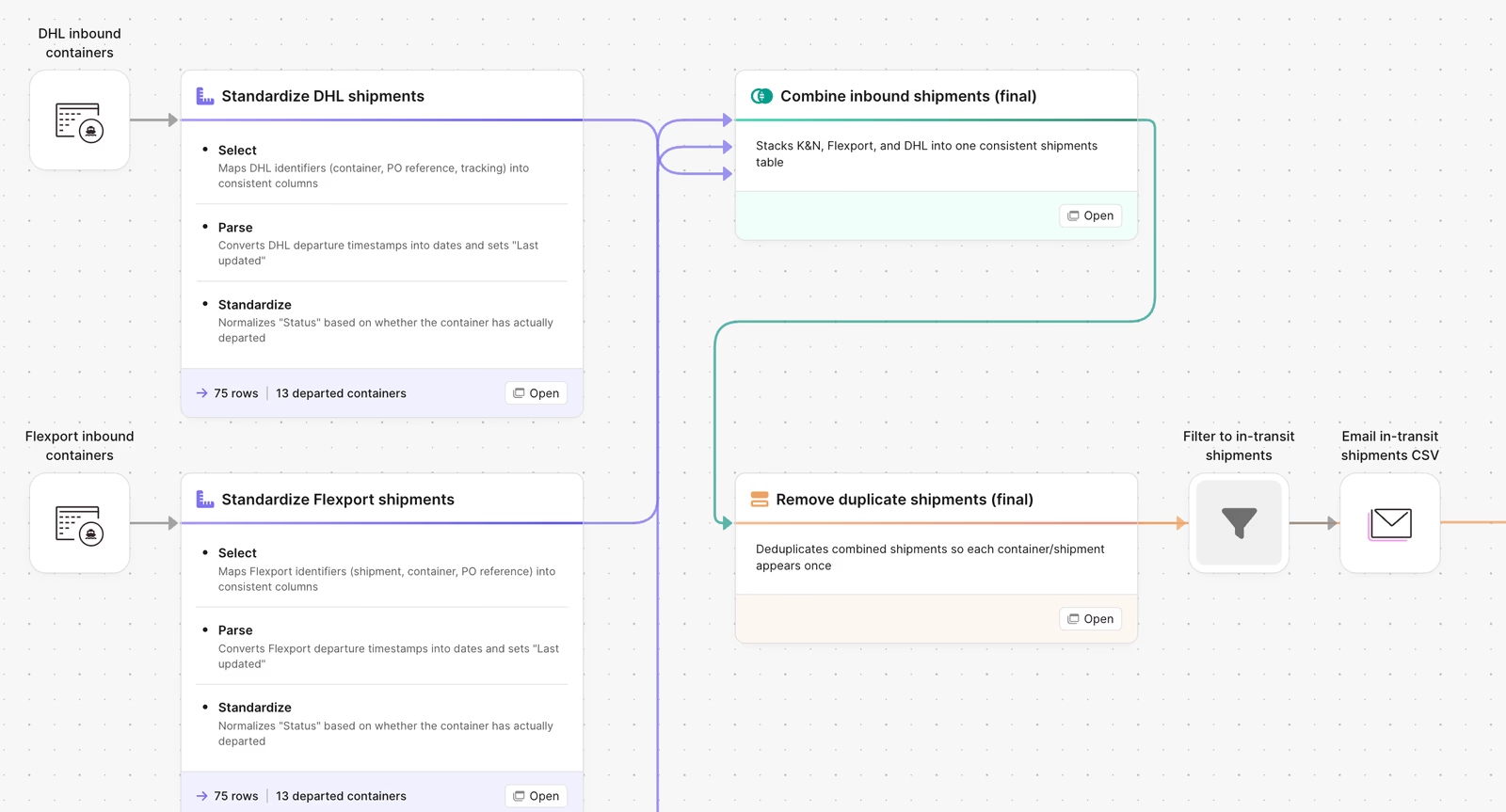
In the mid-market band, the supply chain stack broadens. Operational Reporting and Systems Connectivity become near-universal, and a second tier of supply chain execution workflows joins the top ten. Inbound Shipment Tracking, Track & Trace, and Shipment Data Extraction become routine parts of the deployment, alongside the procurement and inventory workflows carried over from SMB. Inbound Shipment Tracking is a useful illustration of what enters at this band: the workflow pulls carrier and warehouse data into a single tracking view so the team can identify exceptions before they arrive at the warehouse.
Enterprise
In the enterprise band, transportation-layer workflows enter the top ten. Customs & Trade Compliance, Carrier Scorecard Reporting, and Freight Invoice Audit appear alongside the foundational workflows. The companies driving this pattern tend to be logistics-first by nature, where carrier performance and trade compliance sit at the center of the business rather than off to the side. Procurement workflows like SKU Standardization and Purchase Order Tracking drop out of the top ten at this scale, which may reflect that larger enterprises address those problems with dedicated tools or fold them into the supply chain execution work.
Finance
Finance adoption follows a tighter pattern than supply chain. Sales Reporting is the most-deployed finance workflow at every size band, and the workflows that appear alongside it shift as company size increases.
Top finance use cases, by company size
| SMB | Mid-market | Enterprise | |
|---|---|---|---|
| Sales Reporting | |||
| Invoice Parsing & Digitization | |||
| Invoice Audit | |||
| Duties & Landed Cost | |||
| Chargebacks & Deductions | |||
| Accounts Payable |
SMB
In the SMB band, Sales Reporting dominates and Invoice Parsing & Digitization shows up as a meaningful second. Invoice Audit and Duties & Landed Cost are present in some deployments but inconsistent across the band. Finance workflows in this band concentrate on revenue reporting and vendor invoice handling.
Mid-market
In the mid-market band, finance workflows broaden. Sales Reporting remains the leader, with Invoice Audit, Duties & Landed Cost, and Invoice Parsing all appearing across a healthy share of deployments. Chargebacks & Deductions starts to show up here as well, though it remains less common than the workflows above.
Enterprise
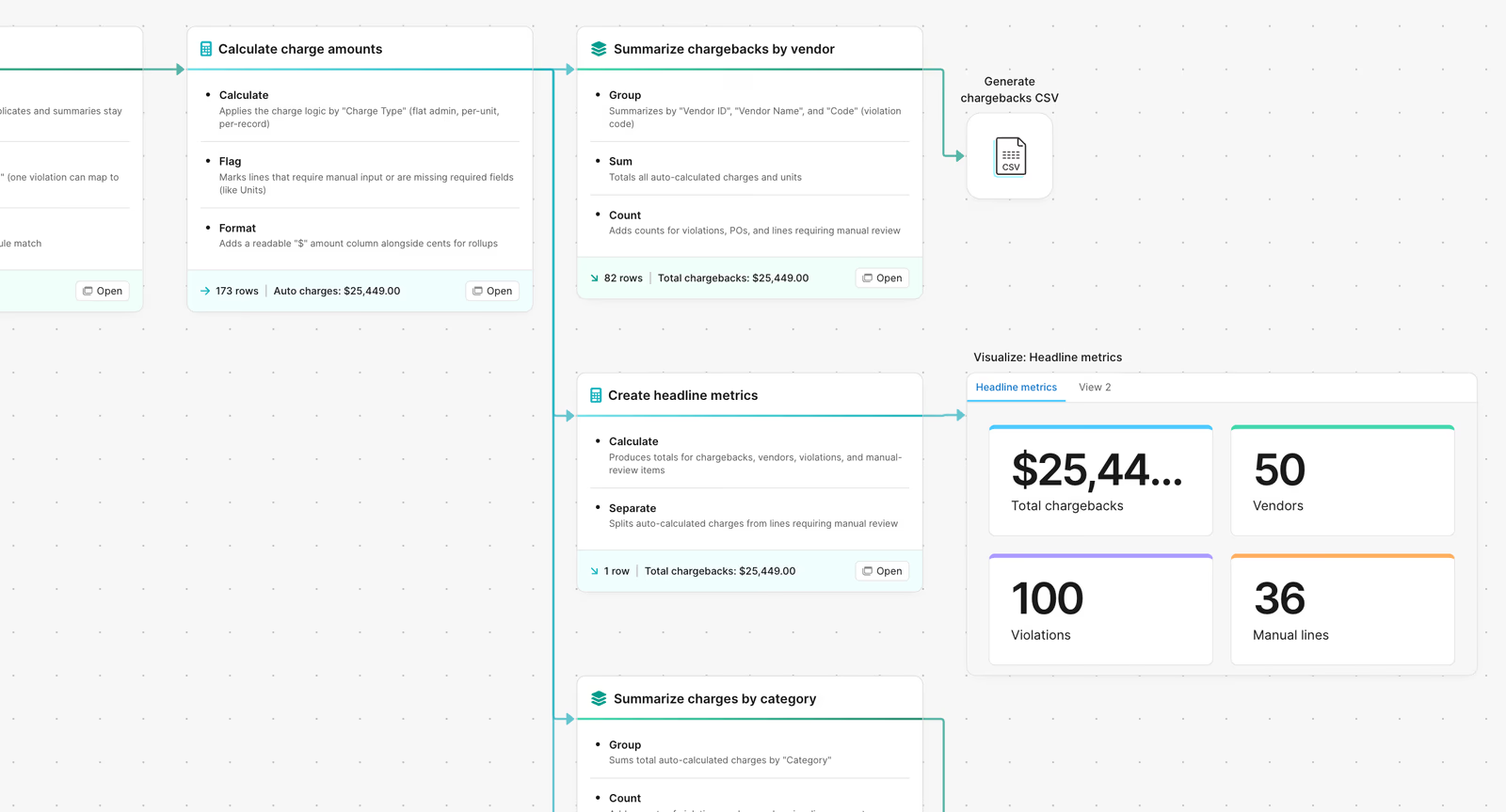
In the enterprise band, two additional workflows enter the top tier: Chargebacks & Deductions and Accounts Payable automation. Both are workflows where the volume of edge cases is the actual problem rather than the structure of the work, and the increased presence of these workflows at enterprise corresponds to the volumes that make manual handling impractical. The Vendor Chargebacks flow is a typical example: deduction line items are pulled from each retailer, categorized by reason code, and the disputable ones are routed to finance for follow-up.
Accounting
Accounting is the most size-gated persona in the dataset. Below 200 FTEs, accounting workflows barely register, and the pattern suggests accounting teams adopt automation reactively, once the close process or the audit trail starts costing too much manual time to maintain. From mid-market onward, the entire close stack tends to follow.
Top accounting use cases, by company size
| SMB | Mid-market | Enterprise | |
|---|---|---|---|
| AR Aging Report | |||
| Cash Reconciliation | |||
| Accrual Calculations | |||
| Spend Classification | |||
| Budget vs. Actuals | |||
| COGS Analysis | |||
| GL Mapping | |||
| Deferred Revenue Reconciliation |
SMB
In the SMB band, accounting automation appears in a small number of deployments. Cash Reconciliation and COGS Analysis are the most common, with occasional AR Aging, Budget vs. Actuals, and Spend Classification deployments. Accounting workflows in this band tend to be one-off rather than part of a recurring program; automation enters through whichever workflow happens to be most acute in a given quarter rather than as a deliberate initiative.
Mid-market
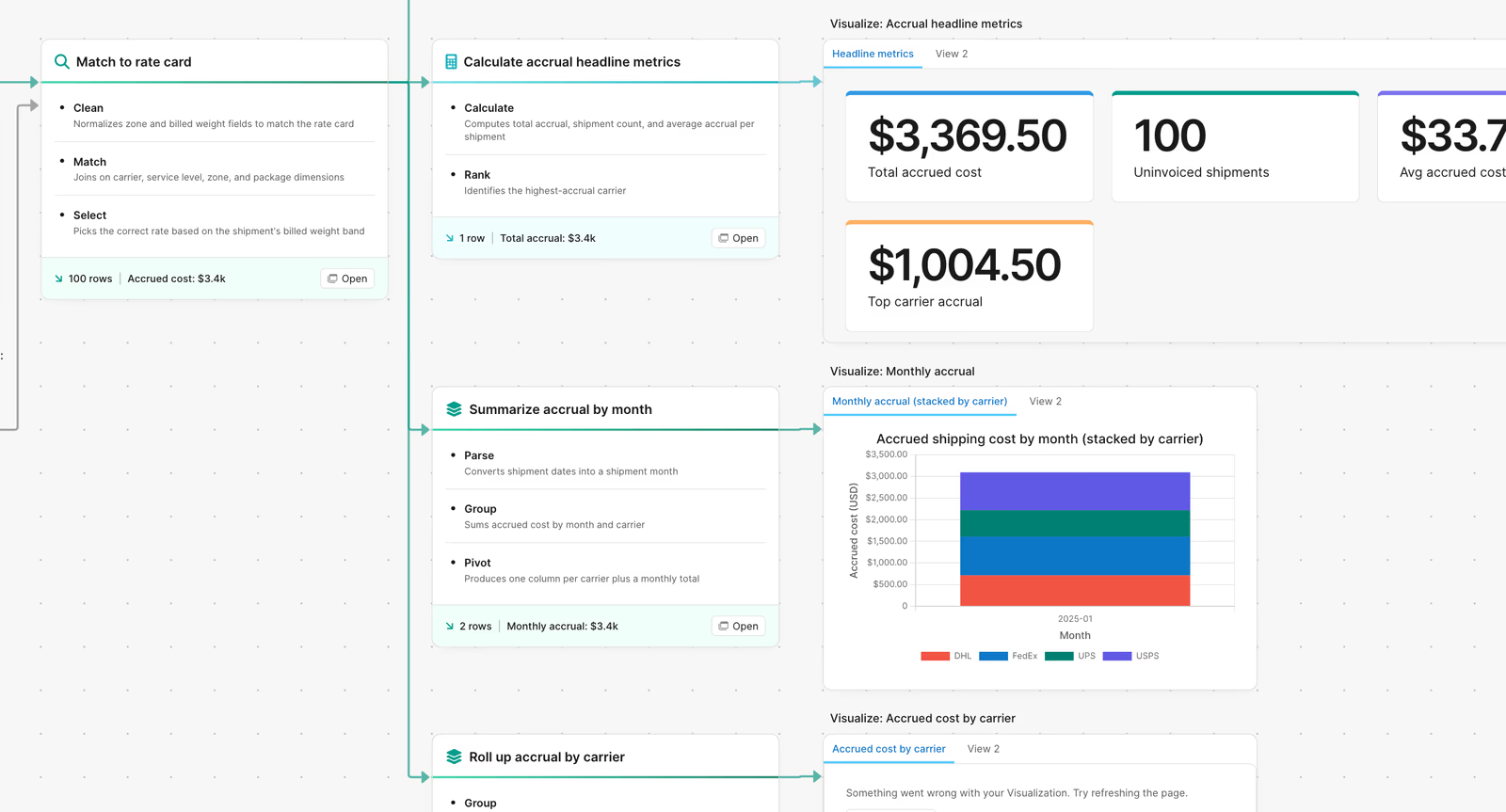
In the mid-market band, accounting workflows become broadly deployed. Accrual Calculations is the most-deployed accounting workflow in this band, and Cash Reconciliation, AR Aging Report, Spend Classification, and Budget vs. Actuals all appear consistently. The workflows align with the recurring rhythm of monthly and quarterly close. The Accrual Calculations flow rolls up prior-period actuals against the accrual ledger and produces the journal entries the close team books each month.
Enterprise
In the enterprise band, the full close stack is present. AR Aging Report leads the persona, followed by Cash Reconciliation, Spend Classification, COGS Analysis, and Accrual Calculations. GL Mapping and Deferred Revenue Reconciliation appear at this size band and not in smaller ones, both reflecting the heavier reporting requirements that come with enterprise-scale finance organizations and the higher cost of getting any of those line items wrong.
By company size
Setting persona aside, each size band has a recognizable deployment shape. New categories of workflow enter the deployment as company size increases, and some earlier workflows either become foundational or drop back out.
SMB (under 200 FTEs)
SMB deployments cover a broad range of workflows relative to team size. Supply chain workflows are the most common across this band: Operational Reporting appears in most deployments, Document Digitization is broadly deployed, and a tail of procurement and inventory workflows fills out the rest. Finance is present but thin, with Sales Reporting as the anchor and Invoice Parsing in a meaningful share of deployments. Accounting workflows are uncommon at this scale; the few that appear tend to be one-off, such as Cash Reconciliation or COGS Analysis, rather than part of a recurring program.
The shape of the SMB deployment is consistent with teams that need to consolidate data across systems they do not have headcount to integrate in other ways. Workflow depth in this band is relatively shallow, and the foundational pair of Operational Reporting and Systems Connectivity is already in place.
Mid-market (201 to 1,000 FTEs)
The mid-market band shows the broadest deployment patterns in the dataset. Operational Reporting and Systems Connectivity / ETL are near-universal across personas, and a second tier of workflows enters each persona's stack. Supply chain teams add execution workflows including Inbound Shipment Tracking, Track & Trace, and Shipment Data Extraction. Finance teams add Invoice Audit and Duties & Landed Cost on top of Sales Reporting. Accounting, which barely registered in SMB, shows broad deployment of Accrual Calculations, Cash Reconciliation, AR Aging Report, Spend Classification, and Budget vs. Actuals across a healthy share of customers.
The mid-market band is where the dataset shows the largest change in deployment shape relative to the smaller band. The number of workflows in active use across personas increases, and the range of workflows widens.
Enterprise (1,000+ FTEs)
In the enterprise band, the foundational workflows from smaller bands remain in place, and an additional set of workflows enters the deployment. For supply chain, the additions are transportation-layer workflows: Customs & Trade Compliance, Carrier Scorecard Reporting, and Freight Invoice Audit. For finance, the additions are Chargebacks & Deductions and Accounts Payable. For accounting, the additions are GL Mapping and Deferred Revenue Reconciliation, joining the rest of the close stack.
The workflows that appear in the enterprise band tend to involve high volumes of edge cases, regulatory or audit requirements, or both. They are workflows that either do not exist or are handled manually in smaller companies, and they become candidates for automation once the manual approach reaches its limit.
Patterns to watch
Across the three personas and three size bands, the data shows a deployment pattern with a shared foundation and persona- and size-specific additions. Most customers in the dataset have Operational Reporting on top of Systems Connectivity / ETL, and most also have Document Digitization in place. The workflows that appear alongside that foundation vary by persona and by company size.
Mid-market is the band where deployment patterns broaden most. For supply chain teams, execution workflows like Inbound Shipment Tracking enter the deployment for the first time. For accounting teams, the entire close stack appears at meaningful scale. Enterprise adds a third tier of workflows characterized by high-volume edge cases or regulatory requirements: Chargebacks & Deductions and Accounts Payable in finance, Customs & Trade Compliance and Carrier Scorecard Reporting in supply chain, GL Mapping and Deferred Revenue Reconciliation in accounting.
The data in this report describes patterns of adoption across the customer base at a single point in time. Subsequent reports will examine how these patterns change as additional customers deploy Prowork and as the use case taxonomy evolves.
Customer stories
.DVABUZQA.png)