Accrual calculations

Build shipping and expense accruals automatically. Match uninvoiced activity to your rate card and roll up by carrier or vendor for month-end close.

The prompt

I want to build a shipping expense accrual for shipments that haven't been invoiced yet. Build me a flow that compares my shipments against my invoices, matches each uninvoiced shipment to an expected rate from my rate card, and shows me a rollup of total accrued costs by carrier.

Just copy and paste the prompt into a new Parabola flow to get started.
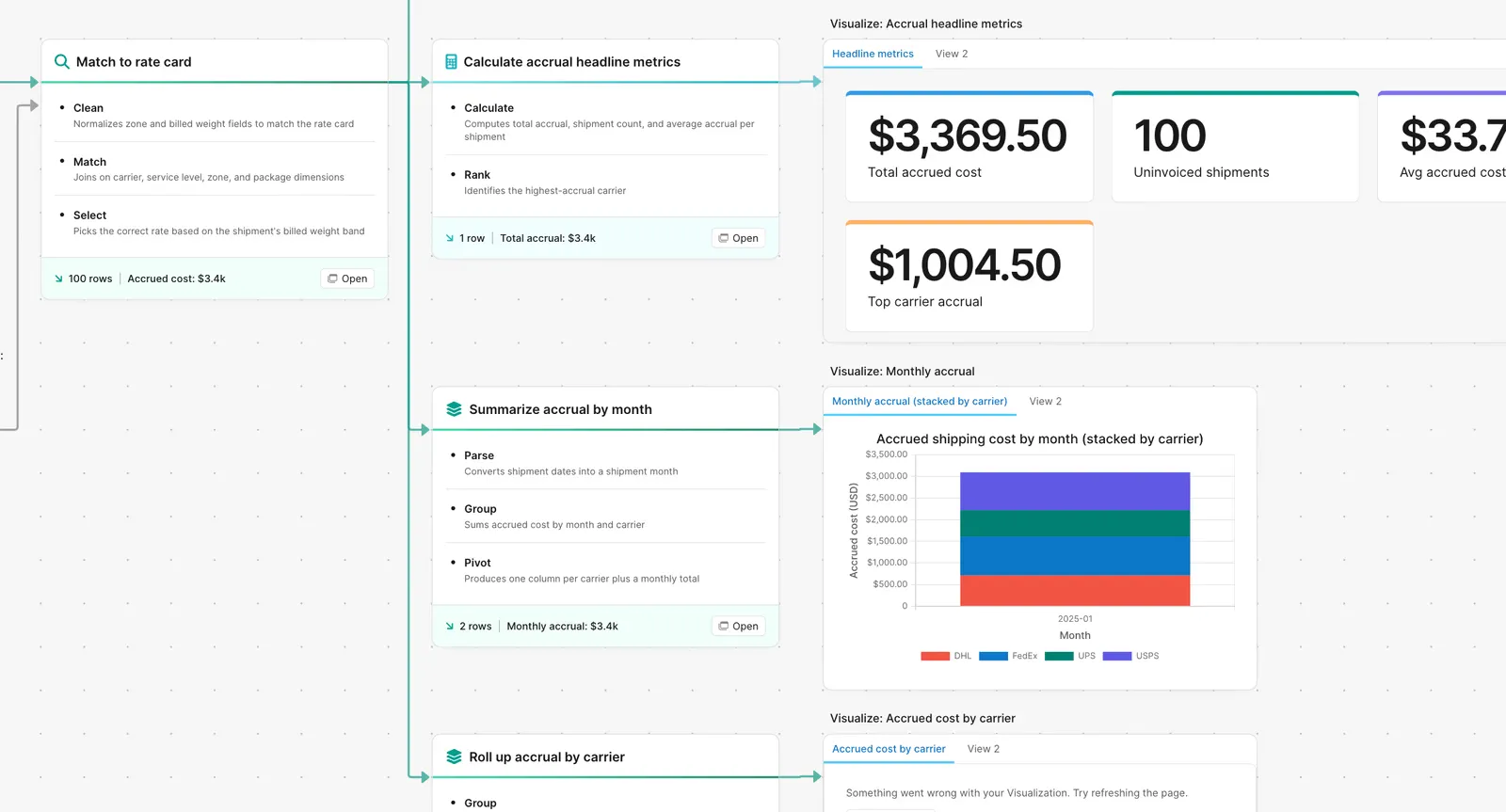
Parabola flow calculating shipping accruals and visualizing headline metrics

What Parabola builds

A workflow with six steps you can edit:

1. Pull the shipment list. From the TMS, the 3PL portal, or the carrier API. Whatever shipped during the period.

2. Pull the invoice list. Carrier invoices that have already landed in AP.

3. Identify the uninvoiced shipments. Anti-join: shipments without a matching invoice.

4. Pull the rate card. Your contracted rate per carrier, service, and zone.

5. Calculate the expected charge. Apply the right rate to each uninvoiced shipment.

6. Roll up by carrier and category. Total accrual amount, journal-entry-ready output.

Why teams stop doing this manually

Shipping accruals live in the gap between "we shipped it" and "the carrier billed us." That gap is usually two to six weeks. By the time the invoice lands, the period has closed and the accounting team is reversing the accrual and booking the actual at the same time.

The manual version is a workbook that pulls shipments, pulls invoices, runs an anti-join in Excel, looks up rates by service and zone, and rolls up the total. Half the cells are formulas referencing cells in tabs nobody documented. The person who built it left. Now it's the new analyst's second-week project, except it's due Friday.

The cost is not the labor. It is the true-up. When the accrual misses by ten percent the close has to flex. When it misses by thirty, the controller is on the phone explaining why margin moved.

How it works

Step 1. Paste the prompt.

Open Parabola, paste the prompt in section 2, and let it ask follow-up questions about your shipment source, rate card structure, and accrual categories.

Step 2. Connect your data.

TMS API or carrier portal export, AP invoice feed, rate card spreadsheet or pricing system.

Step 3. Run it every period.

Monthly close, weekly true-up, or daily during peak.

FAQ

Can the flow output a journal entry I can upload to my GL?

Yes. The rollup step outputs a journal-entry-ready table with debit and credit columns, GL account, period, and memo. Some teams push directly to NetSuite or SAP, others output a CSV the close team uploads.

What happens when the invoice finally arrives?

The next-period flow flips the line from accrued to actual and surfaces any variance. The variance report goes to whoever owns the true-up.

We use multiple rate cards across regions. Can the flow handle that?

Yes. Each rate card lives as a separate reference table. The match step routes each shipment to the right rate card based on region, carrier, or service.

How do we handle shipments that span period boundaries?

Configurable cutoff. Some teams accrue based on ship date, others based on tender date or first carrier scan. The flow lets you pick one and apply it consistently.

Does this work for non-shipping accruals?

Yes. The same pattern works for storage, fulfillment, commissions, or any expense category where activity precedes the invoice.
Close the books on accruals you can defend.
Paste the prompt, point it at your shipments and rate card, and let the accrual build itself.
Start for free