Vendor chargebacks reporting

Match every retailer chargeback to its pricing rule. Roll up by vendor and violation code so disputes get filed faster and root causes show up.

The prompt

I want to build a vendor chargebacks report. Build me a flow that matches each vendor violation to its pricing rule, calculates the total charge amount based on the charge type, and summarizes everything by vendor and violation code.

Just copy and paste the prompt into a new Parabola flow to get started.
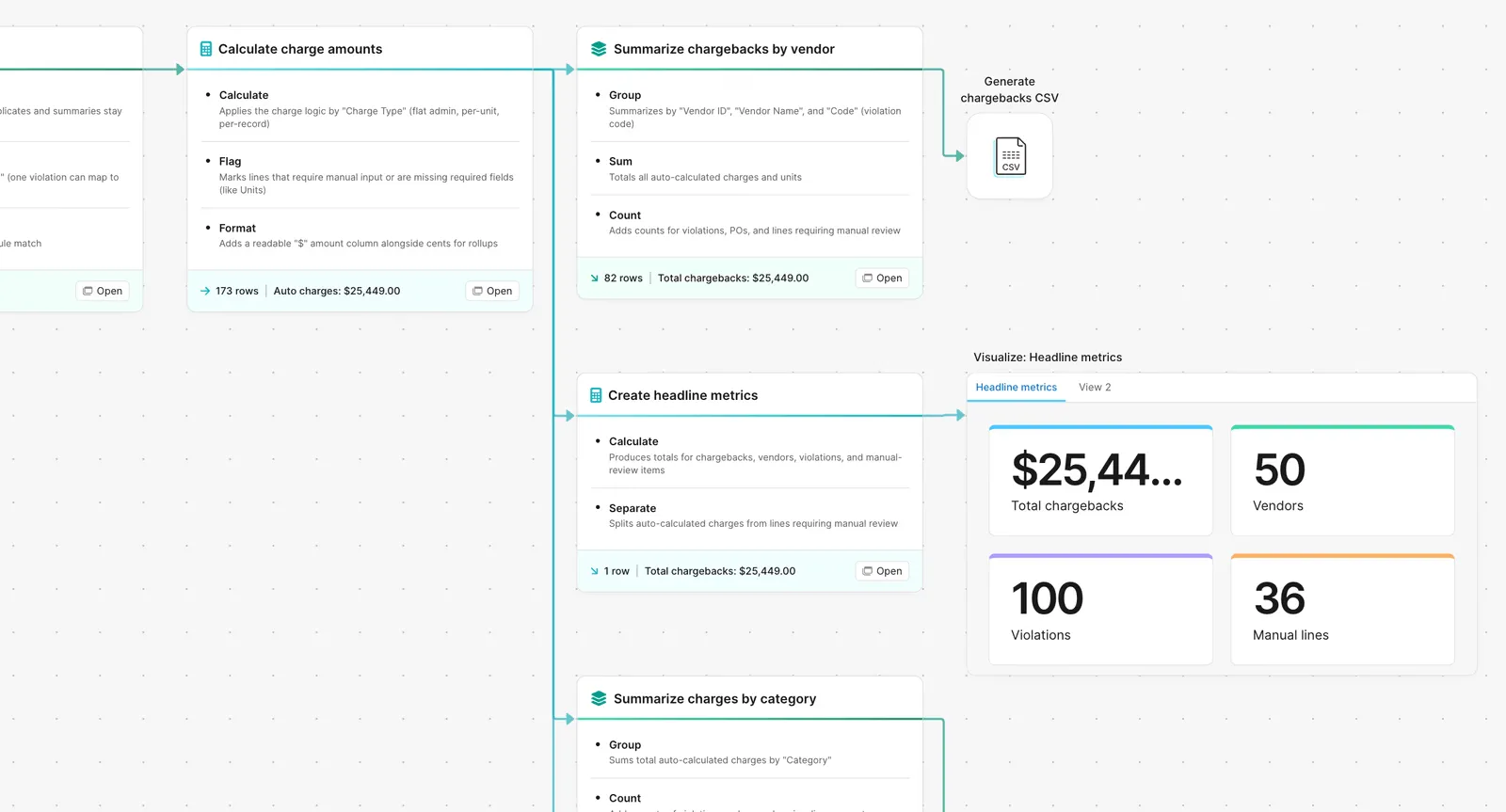
Parabola flow calculating vendor chargebacks by violation and surfacing headline metrics

What Parabola builds

A workflow with six steps you can edit:

1. Pull the chargeback file. Whatever the retailer sent: portal export, EDI 812, PDF, or a remittance buried inside an email.

2. Standardize the format. Each retailer codes its violations differently. The flow normalizes them into a common schema.

3. Match each violation to its pricing rule. Late, short ship, label, packaging, ASN error. Each rule has its own charge formula.

4. Calculate the charge amount. Per-unit, per-PO, percentage of invoice. Whichever the contract calls for.

5. Summarize by vendor and code. One row per vendor per violation type with totals and counts.

6. Output the report. Full chargeback table for the record, plus a dispute-ready view sorted by dollar amount.

Why teams stop doing this manually

Every retailer codes chargebacks differently. Nordstrom does it one way. Sephora another. Walmart and Target each have their own portals and their own naming conventions. The team has to translate every format into the same schema before they can even start asking what caused the charge.

So the work splits in three. First the analyst figures out what the chargeback actually means. Then they figure out who in the org caused it. Then they file the dispute. The first two parts eat the day. The disputes pile up. The ones that don't get filed in the window become accepted losses by default.

Most teams know the chargeback isn't always the team's fault. The retailer's system shows a late ship that the carrier scan disputes. The packaging violation cites a spec the brand never agreed to. None of that gets caught when the work is hours of manual triage on a deadline.

How it works

Step 1. Paste the prompt.

Open Parabola, paste the prompt in section 2, and let it ask follow-up questions about your retailer mix and pricing rules.

Step 2. Connect your data.

Retailer chargeback exports (portal CSV, EDI, PDF, or remittance email), your pricing rules table, and the channel you want results in.

Step 3. Run it every cycle.

Weekly or monthly. New retailer? Add a new pipeline that follows the same pattern. New pricing rule? Update the rules row.

FAQ

Will this work if my retailers send EDI 812s and others send PDFs?

Yes. Each retailer gets its own pipeline that handles its format, then they all feed the same summary. The AI extraction step pulls the line items from EDI, CSV, or PDF.

Can the flow flag chargebacks I should dispute first?

Sort the output by absolute dollar variance descending. Most teams dispute the top 10 to 20 percent by dollars and accept the small ones. You can also tag chargebacks where the root cause looks like a retailer-system error rather than something your team caused.

How does this handle retailer-specific violation codes?

The flow keeps a normalized internal taxonomy plus a mapping table from each retailer's codes. When a retailer renames a code or adds a new one, you update the mapping row, not the workflow.

We process chargebacks in SAP today. Does this replace that?

No. The flow runs ahead of SAP, so by the time the chargeback lands in the system it's already categorized, matched to its rule, and rolled up. The ops team reviews the dispute-ready view instead of building it from scratch.

How is this different from doing the report in Excel?

Excel works fine until you're managing twelve retailers, three pricing-rule iterations a year, and dispute windows you keep missing. Parabola handles inconsistent inputs, runs on a schedule, and shows every decision the flow made so finance and wholesale can audit the audit.
File the dispute before the window closes.
Paste the prompt, point it at your chargeback files and pricing rules, and let the report build itself.
Start for free